

Bear Behavior Explained: Hibernation, Communication, Intelligence, and More
Last updated: November 5, 2026
11 min read
Bears are not the lumbering, slow-witted animals folklore makes them out to be. They are among the most intelligent carnivores on Earth, with a hibernation system biologists are still unpicking, a communication repertoire that runs from low huffs to tree marks well above head height, and a family structure as careful as any mammal’s. This guide pulls together what bear behavior actually looks like across the eight species.
A note on scope. Bears cover a huge range of behavioural variation: a sloth bear ripping into a termite mound in Sri Lanka is doing different work to a polar bear on a seal-stalking lie-up in Svalbard. Where the eight species converge we say so; where they diverge sharply we flag it. Most of the high-profile behavioural research focuses on North American black bears, brown bears, and polar bears, with growing camera-trap and GPS data filling in the harder-to-study sun, sloth, and spectacled bears.
Explore the bear knowledge hub
- Types of Bears: all 8 species explained
- Bear Gifts: best gifts for bear lovers
- Bear Safety: encounters, spray, prevention
- Bear Conservation: threats and how to help
- Fat Bear Week: champions, bracket, bears
- Bear Photography: photographing wild bears worldwide
Hibernation: not the simple winter sleep you think it is
The classic mental image, bear curls up in cave in November, wakes in April, is roughly right and substantially wrong.
True hibernation vs torpor
Mammalogists used to argue that bears do not truly hibernate, because their body temperature only drops by a few degrees Celsius, against ground squirrels that crash to near freezing. The view has shifted. Bears hold body temperature high enough to wake quickly if disturbed while still cutting metabolic rate by roughly three quarters, and they go five to eight months without eating, drinking, urinating, or defecating. Most bear researchers now treat that as hibernation in its own right rather than as a lesser version of it.
The detail differs between species:
- Brown and black bears of cold-temperate latitudes hibernate hardest. A bear in Yellowstone or on the Alaska Peninsula will be denned from late October or November to April or May.
- Polar bears generally do not hibernate as adults. Only pregnant females den, on land or in maternity snow caves, fasting for months.
- Sun bears, sloth bears, and spectacled bears do not hibernate at all. They live in climates with year-round food and no need for the metabolic adaptation.
- Giant pandas do not hibernate. Bamboo is available year-round and is far too low in calories to fuel a long fast.
- Asiatic black bears hibernate in the colder parts of their range, such as the Russian Far East and northern Japan, but not in the tropical south.
Cubs born during the den
The most extraordinary bear-behaviour fact: brown and black bear cubs are born in January or February, deep in the mother’s hibernation. Cubs weigh about 300 to 500 grams at birth, less than half a percent of the mother’s body weight, which is tiny for a placental mammal. Giant panda cubs are smaller still relative to the mother. They are blind, almost hairless, and entirely dependent on milk that is very high in fat, in the region of 20 to 30 percent depending on species and stage, against about 4 percent for human milk.
The sow stays in a state of hibernation-cum-nursing for the rest of the den period. She wakes enough to lick cubs, reposition them, and respond if they fall away from her body warmth, but does not eat, drink, or fully rouse. When she emerges in April or May the cubs come with her: walking, fur grown out, weighing 3 to 5 kg.
Delayed implantation
Bears mate in late spring or early summer, but the fertilised embryos do not implant in the uterine wall until autumn, after the female has put on enough fat to support a pregnancy. If she has not, the embryos are resorbed and no cubs are born. This is delayed implantation, and it is the safety valve that keeps the energetics of the hibernation-birth system workable. It is also why hyperphagia, the autumn eating frenzy, matters so much. See Fat Bear Week for the most public example of hyperphagia in action.
Bear communication: vocal, scent, and visual
Bears are far more chatty than the silent-stalker image suggests. They just do most of it quietly, off-trail, and through scent.
Vocalisations
- Huffs and chuffs. Short, exhaled bursts. The default “I am uncomfortable” or “back off”. Black bears especially.
- Jaw-popping. Defensive warning. Often accompanies a bluff charge.
- Woof or bark. Alarm. A sow uses this to send cubs up a tree.
- Roar. Rare. Mostly males in serious dispute, or a bear in significant pain.
- Moans, hums, and bawls. Cubs to mothers and mothers to cubs.
- Silence. Predatory bears almost never vocalise. A silent stalking bear is far more dangerous than a huffing one. See our bear safety guide.
Scent marking
This is the main channel. Bears live in olfactory landscapes humans simply cannot perceive.
- Bear trees. A standard scent post, used by generations of bears. A bear rubs its back against the bark, bites the trunk at full height, which is why the highest claw mark is sometimes used as a rough size proxy, and may urinate at the base. Other bears reading the tree pick up the visitor’s species, sex, breeding status, and approximate size. Well-used trees show wear and claw marks well above head height.
- Anal gland secretions. Discreet but information-dense. Bears scuff and twist their hindquarters against logs and rocks.
- Pad scent. Bears have glands in the foot pads. The stiff-legged, swaying “cowboy walk” you see on the cams is a deliberate scent-spreading walk.
Body language and visual signals
- Ears. Forward and up means attentive or aggressive. Flat and back means defensive.
- Body orientation. A sideways-on stance with the head low can be a dominance display. Head-on with the mouth open is more threatening.
- Bluff charges. Most charges are bluffs. The bear runs, then peels off or stops. Real attacks are quieter and lower to the ground.
- Standing up. Almost always curiosity or a better view, not aggression. A bear on its hind legs is trying to see, hear, or smell more.
How smart are bears?
Bear intelligence has been underestimated for most of the history of bear research. The last 30 years have reset expectations:
- Brain size. Bears have large brains for their body size compared with most carnivores.
- Tool use. In July 2011 Volker Deecke of the University of Cumbria watched a wild brown bear in Glacier Bay, Alaska, pick up a barnacle-covered rock and rub it against its face and neck. He published it in 2012, and it stands as the first documented case of tool use in a brown bear.
- Problem solving. In a 2016 zoo study of 39 carnivore species, bears opened a food puzzle box about 70 percent of the time, the best of any family tested.
- Memory. Brown bears remember productive berry patches for years at a time.
- Self-recognition. Inconclusive. The mirror test has not produced a clean bear pass, though bears do behave differently in front of mirrors in ways that are hard to explain as pure other-animal interpretation.
- Quantity discrimination. Captive black bears trained on touchscreen tasks can tell different quantities apart at well above chance.
The practical takeaway: bears solve problems by trial and error fast enough that bear-resistant gear has to anticipate several rounds of the bear figuring out the latch. The standard IGBC-certified bear-resistant container is tested by giving captive bears 60 minutes of access. The bears keep trying for the full hour.
Foraging: omnivores adapted to their landscape
Bears sit in the order Carnivora, but seven of the eight species are functional omnivores, with diet composition varying enormously by species and season.
- Polar bear. The most carnivorous. Ringed and bearded seals, especially pups, make up the great bulk of the diet. Polar bears use stand-hunting at breathing holes, still-hunting of basking seals, and, less often and less successfully, aquatic hunting.
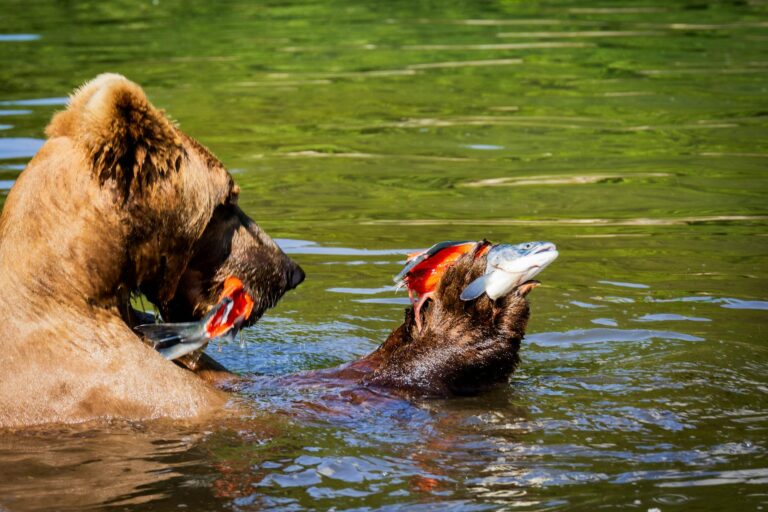
- Brown bear and grizzly. Highly variable. Coastal Alaskan bears eat heavily on salmon during the runs. Interior Yellowstone grizzlies take cutthroat trout, whitebark pine nuts, army cutworm moths, elk calves in spring, and roots and tubers. Grass and sedge meadows provide spring bulk.
- American black bear. Mostly plant material, typically 75 to 85 percent, with insects, fish, and opportunistic mammals making up the rest. Acorns and beechnuts drive autumn fat gain in the eastern US.
- Asiatic black bear. Similar but more nut-dominated. Oak and beech mast crashes are a major driver of human-bear conflict in Japan.
- Sun bear. Insects, especially termites and beetle larvae, plus tropical fruit and honey. The famous long tongue, up to about 25 cm, is built for extracting them.
- Sloth bear. The specialist. Termites and ants make up over half the diet. Sloth bears lack the two central upper incisors, leaving a permanent gap, and can close their nostrils voluntarily, which together let them suck insects out of a mound like a vacuum nozzle.
- Spectacled bear. Mostly vegetarian. Bromeliads, palm hearts, fruit, and the occasional small mammal.
- Giant panda. Effectively an obligate bamboo specialist, around 99 percent bamboo by volume, despite a digestive system still wired for carnivory. Pandas spend most of the day eating because bamboo is so poorly digestible.
Seasonal patterns
The annual cycle for a temperate brown or black bear:
- April to May. Emergence. Bears are thin and sluggish. Sows have new cubs. Spring grass and overwintered carrion are the first food, and cougar and wolf kills get scavenged aggressively.
- June to July. Mating season. Males roam, scent-mark heavily, and fight for breeding access. Cubs are at high risk of infanticide from incoming males, and females with cubs avoid the bigger bears, sometimes by pushing into marginal habitat.
- Late July to September. Hyperphagia. Weight gain of up to about 2 kg a day. Salmon runs on the coast, berry crops inland. Aggression between bears at concentrated food sources peaks here.
- October to November. Den preparation. Bears dig or refurbish dens, line them with branches and grass, and enter when snow cover and cold are right.
- November to April. Hibernation, and cubs.
For sun bears and sloth bears the pattern is different. There is no winter retreat. Activity peaks loosely follow fruiting seasons, but the bears are active all year.
Family life and parental behaviour
Sows are single mothers. Males contribute nothing to parental care and are a major cause of cub deaths.
- Litter size. Brown and black bears: typically two cubs, occasionally one, three, or four. Polar bears: usually two. Sun, sloth, and spectacled bears: typically one or two.
- Cub-mother bond. Cubs stay with the mother for 1.5 to 3.5 years depending on species and food. Black bears typically push cubs out in their second spring, around 17 to 18 months. Brown bears often keep cubs for two to three years. Polar bears, about 2.5 years.
- Family group dynamics. Sows are protective enough that a mother with cubs is the most dangerous bear encounter in most of North America. That defensive response is calibrated against males who would kill cubs to bring the female back into oestrus.
- Adoption. Rare but documented. A small number of sows have raised orphaned cubs alongside their own, the best-known case at Brooks River being Bear 435 Holly taking on the orphan 503.
- When cubs leave. The mother drives them off at the start of the breeding season in their final spring. Siblings sometimes stay together for another summer before dispersing, especially black bears.
Bear myths busted
Worth flagging, because they are everywhere and some of them get people hurt.
- “Bears hug their prey to death.” No. Bears use teeth and claws, not crushing embraces. The myth probably comes from sloth bears pulling prey close while biting.
- “All bears hibernate the same way.” No, see above. Polar bears barely hibernate and tropical bears do not at all.
- “Black bears are harmless and brown bears are aggressive.” Misleading. Predatory attacks are somewhat more likely from black bears in some regions; defensive attacks from grizzlies are more famous. The right response depends on the encounter type, not the species.
- “Climb a tree to escape.” No. Black bears climb far better than people, and a motivated grizzly can get up a suitable tree. Climbing is not an escape.
- “Bear bells scare bears away.” Inconclusive at best. Most modern bear-country guidance favours talking, clapping, and clinking poles. Bells are not a substitute for bear spray.
- “Cubs are abandoned, pick them up.” Almost never abandoned. The sow is probably 50 metres away and seriously upset. Walk away.
- “Bears can smell food 20 miles away.” The specific distance figures that get quoted are hard to trace back to any study, and they vary wildly depending on who is repeating them. What is solid: a bear’s sense of smell is among the best of any land mammal, and it will detect food and carcasses long before you have any idea it is there. Treat the exact mileage as folklore and the capability as real.
More on how bears live
- Can Bears Climb Trees? Which Species and How Well
- How Long Do Bears Live? Lifespan in Wild and Captivity
- What Do Bears Eat? Diet by Species and Season
- How Smart Are Bears? Intelligence, Memory, and Problem-Solving
- How Bears Communicate: Sounds, Scent, and Body Language
- Bear Hibernation: How and Why Bears Hibernate
- Bear Phobia: Why Humans Fear Bears (and Why the Fear Is Out of Proportion)
- Are Squirrel Grain Stockpiles To Blame For Bear-Train Collisions?
- NYDEC Tracks Black Bear Den
- Orphaned Cub Accepted by Another Mother
- Brown Bear Attacks a Sow and Dies
FAQ
Do all bears hibernate?
No. Of the eight species, brown bears and American black bears hibernate consistently across most of their range. Asiatic black bears hibernate in colder regions only. Polar bears do not hibernate as adults; only pregnant females den. Sun bears, sloth bears, spectacled bears, and giant pandas do not hibernate at all, because they live where food is available year-round. Depth and length vary by latitude, food year, and the bear’s condition going in.
How smart are bears?
Bears are among the most intelligent carnivores, with large brains for their body size. Zoo bears open food puzzle boxes more often than other carnivores, and captive black bears can discriminate quantities on touchscreen tasks. A wild brown bear has been filmed using a barnacle-covered rock as a scratching tool. And bear-resistant containers have to survive a full hour of focused effort from a test bear to be certified.
Do bears really hug?
Not in the way the lore suggests. Bears fight with teeth and claws. The closest real behaviour is a sloth bear or sun bear pulling food close to the body while biting, or a sow gathering cubs in for warmth. There is no crushing-embrace attack technique in any bear species.
How do bears communicate?
Mainly through scent: bear trees, anal gland secretions, and foot-pad scent left on deliberate marking walks. Then vocalisations, from huffs and jaw-popping to cub bawls. Then body language: ear position, head orientation, bluff charges, standing up. Scent is the dominant channel, and a single well-used bear tree passes on the visiting bear’s species, sex, breeding status, and rough size to everything that comes after.
Why do bears stand on hind legs?
Almost always to see, hear, or smell more clearly. A bear on its hind legs is curious or cautious, not aggressive. The pose puts its nose and ears at a better height and lets it look over vegetation. An aggressive bear stays on all fours, lowers its head, flattens its ears, and may bluff-charge. The Hollywood image of a roaring bear rearing up to attack is wrong.
Related guides
- Types of Bears for full species profiles and comparison
- Bear Safety for how to apply behaviour reading in the field
- Bear Conservation for the broader picture
- Fat Bear Week for hyperphagia in action
- Food-conditioned vs habituated bears for an important behavioural distinction
This article is part of our bear facts guide, which links every article on bear behaviour, safety and culture.
Updated 28 September 2026: corrected cub birth weight, the puzzle-box research, hibernation body temperature and daily weight gain.

I always pictured a denning bear as out cold all winter. A mother waking to lick and move her cubs while still not eating or drinking for months is something else.
Jaw-popping is the one sound on that list I’ve heard in person. A black bear on a trail near our cabin did it at us before turning off into the trees, and none of us knew what it meant until much later.