
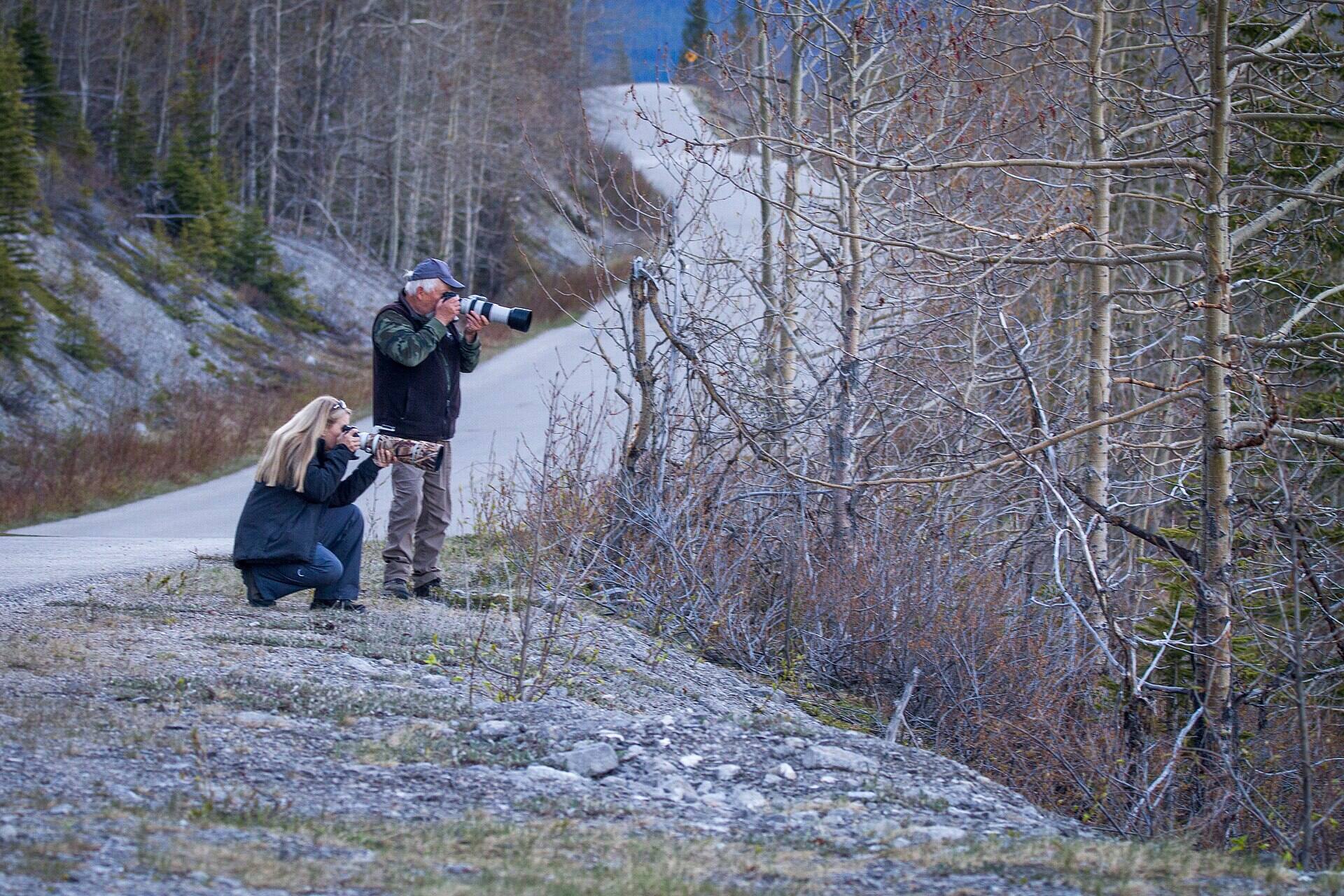
Bear Photography: A Complete Guide to Photographing Wild Bears
Last updated: October 14, 2026
10 min read
A frame-filling brown bear lifting a salmon out of the spray at Brooks Falls is not a lucky accident. It is the result of a season chosen, a lens picked, a permit secured, a position held for hours, and a long sequence of small, ethical decisions made well before the shutter ever fires.
Bear photography sits at the intersection of wildlife biology, travel planning, optical physics, and patience. The animal will do what the animal does. Your job is to arrive at the right place, at the right time, with the right gear, and to keep enough distance that the bear never has a reason to register you. This guide covers every layer of that work: when to go, where to stand, what to carry, how to compose, how to behave, and where the resulting images can earn a life of their own.
Explore the bear knowledge hub
Six more comprehensive guides covering every aspect of bears:
- Types of Bears: all 8 species explained
- Bear Gifts: best gifts for bear lovers
- Bear Safety: encounters, spray, prevention
- Bear Conservation: threats and how to help
- Fat Bear Week: champions, bracket, bears
- Bear Behavior: hibernation, intelligence, communication
The four conditions that produce a publishable bear image
Every good wild-bear photograph satisfies four conditions. Miss one and the image is a snapshot. Hit all four and it can carry a magazine cover.
| Condition | What it means | How you control it |
|---|---|---|
| Light | Low angle, soft, directional | Shoot 30 minutes before sunrise to 90 minutes after, and 90 minutes before sunset until dusk. Overcast counts as soft light all day. |
| Behaviour | The bear is doing something other than walking | Time your trip to a feeding or breeding peak: salmon runs, hyperphagia, courtship, cub emergence. |
| Distance | The bear is close enough to fill the long edge of the frame, but not stressed | Use 400 to 800 mm of focal length and accept that your feet stay rooted. |
| Background | The frame reads as wilderness, not a zoo | Pre-scout your position so the bear is set against river, forest, tundra, snow, or fog, never against a fence, a path, or a parked vehicle. |
When to photograph bears: the seasonal calendar
Bears are not on call. They are governed by hibernation, hyperphagia, salmon runs, berry seasons, and cub schedules. Pick the wrong month and you will photograph an empty meadow.
Spring (April to early June)
Bears emerge skinny and hungry. Cubs of the year leave the den with their mother in late March to May depending on latitude. Diet is grass shoots, winter-killed carcasses, and ant logs. Photograph: cub emergence, lean post-hibernation profiles, courtship chases in late May and early June. Light is long and soft, snow lingers as a graphic background, and the bears work hard enough to ignore distant observers.
Summer (mid-June to mid-August)
The lean season between spring greens and salmon. Bears spread out and are harder to find. Polar bears in Hudson Bay are stranded ashore and lethargic. This is the weakest window for North American brown bears but the strongest window for European brown bears in Romania, Slovenia, and Finland.
Autumn (late August to October)
The single richest window. Salmon runs peak across coastal Alaska and British Columbia. Bears enter hyperphagia and gain up to about 1.8 kg (4 lb) a day. Brooks Falls runs its Fat Bear Week vote in late September into October. In the Rockies, whitebark-pine and berry seasons concentrate grizzlies. Polar bears converge on Cape Churchill from late October to mid November. Most professional wildlife photographers build their year around this window.
Winter (November to March)
Mostly off-season; bears are denning. The exception is polar bears around Churchill before freeze-up. Winter is the time to edit and pitch what you shot in autumn.
Where to photograph bears: the global short-list
Six destinations cover the great majority of wild-bear photography produced for publication each year. Each has its own deeper guide on this site:
- Katmai and Lake Clark National Parks, Alaska: coastal brown bears at salmon, June to September. See our Alaska bear viewing guide.
- Yellowstone and Grand Teton, Wyoming: roadside grizzlies and black bears in Lamar and Hayden Valleys, May to July and September to mid October. See our Yellowstone bear watching guide.
- Churchill, Manitoba: tundra-buggy polar bears, mid October to mid November. See our Churchill polar bear tour guide.
- Carpathian Mountains, Romania: hide-based brown bears from Brasov, June to September. See our Carpathian bear watching guide.
- Hokkaido, Japan: boat-based brown bears on the Shiretoko Peninsula, August to October. See our Hokkaido bear watching guide.
- Andean cloud forest, Ecuador: the only realistic spectacled bear window, October to December. See our Andean bear photography guide.
For a wider comparison including Anan, Kodiak, Slovenia, and Kamchatka, see our 10 best places to see bears in the wild.
What to photograph bears with: the gear ladder
The single biggest predictor of image quality is focal length. The second is your willingness to walk a long way carrying it.
Bodies
Any modern mirrorless body with phase-detect autofocus will do the job. What matters for bears is animal-eye detect, 10 to 20 fps continuous shooting, and weather sealing. The Sony Alpha 1 and A9 III, Canon R5 Mark II and R3, Nikon Z8 and Z9, and OM System OM-1 Mark II are the standard kit at Brooks Falls and on the Churchill tundra buggies. An older crop-sensor DSLR remains useful: the crop factor effectively lengthens your lens.
Lenses
| Use case | Focal length | Notes |
|---|---|---|
| Fishing bear at Brooks Falls | 400 to 600 mm full-frame | 500 mm or 600 mm f/4 primes, or 100 to 500 mm zooms. |
| Environmental wide | 70 to 200 mm | On a second body to avoid lens swaps. |
| Tundra buggy polar bears (20 to 50 m) | 200 to 600 mm zoom | Zoom beats prime: bears can pop up close to the buggy. |
| Romania hide (30 to 60 m) | 300 to 600 mm | Tripod-mounted, often with a 1.4x teleconverter. |
| Ecuador cloud-forest spectacled bear | 100 to 400 mm, fast | Light is poor under canopy: prioritise f/2.8 to f/4 over reach. |
A 1.4x teleconverter is the cheapest way to add reach (one stop of light cost, slight AF speed cost).
Support and clothing
For anything 400 mm and above, a gimbal head on a sturdy tripod (the Wimberley WH-200 is the industry standard) is the difference between sharp keepers and frustration. On boats and tundra buggies, a beanbag or clamp-mounted gimbal works better than legs. Bears do not care what colour you wear, they care about movement: pick quiet, breathable, weather-proof layers in muted greens, greys, or browns. For Katmai expect rain every day and bring waders. For Churchill bring a parka rated to minus 40 C, glove liners under heavy mittens, and chemical hand warmers. For Romania and Hokkaido, fleece under a waterproof shell. Camera rain covers are not optional anywhere on this list.
How to compose a bear photograph
Composition is what separates a record shot from a portfolio image.
Get the eye sharp at the bear’s eye level
Animal-eye autofocus is nearly automatic, but only if the eye is visible. Wait for the head turn. Then drop low: a waist-high tripod flattens a bear and includes too much ground. Sit or lie down where it is safe and permitted. Eye-level images make the viewer feel like a fellow bear, not a tourist on a platform.
Use motion intentionally
Freeze at 1/2000 s and faster for water droplets and salmon mid-flight (the classic Brooks Falls shot). Pan at 1/30 to 1/125 s while tracking a running cub to turn the background into streaks. Hit rate is low; keepers are striking.
Compose in three layers
A bear filling 90 percent of the frame is a portrait. A bear at 10 percent against tundra, glacier, or forest is a story. Editorial buyers usually prefer the wide. Move two metres left or right until foreground, midground, and background stack into three readable layers.
Shot ideas to chase
A working list to tick off across seasons:
- Cubs of the year emerging from the den, late April to mid May, Yellowstone or Romania.
- Bear fishing for salmon mid-air, July and September, Brooks Falls or McNeil River.
- Hyperphagia profile, late September, any Alaska coastal site. The fat fold over the front shoulders is the signature.
- Courtship pair, late May to mid June, almost any location.
- Polar bear and cub at Cape Churchill, late October to mid November.
- Foraging on a berry slope, August in Glacier National Park or Romania.
- Hibernation den entrance, October to November in snow; requires a local biologist.
- Cantabrian and Apennine brown bears, see the Cantabrian brown bear species profile.
Ethical practice: the rules that keep both you and the bear alive
This is the section that should be tattooed to the inside of every photographer’s lens cap. Ethics is not separate from craft. Bears that are habituated, baited, or chased produce worse photographs because they behave abnormally and because eventually they get shot for becoming a problem animal.
Keep your distance
There is no single national minimum, so check the park you are actually standing in. Yellowstone and Grand Teton require 100 yards (91 m) from bears and wolves. Katmai has its own published rule: under 36 CFR 13.1206 it is prohibited to approach within 50 yards of a bear, and prohibited to keep occupying a position within 50 yards of a bear that is using a concentrated food source such as spawning salmon. Several parks outside the US use 100 m. If a bear approaches you, move away to restore the gap. Filling the frame is your lens’s job, not your feet’s.
Never bait or feed
Food-conditioned bears are dead bears. Do not leave packs unattended, eat where you photograph, or toss a snack to draw a bear closer. Scent-baiting outside a licensed biologist-managed hide programme is illegal and unethical. Romanian accredited hides use regulated carrion or fruit placed before the bears arrive; improvising it yourself in a national park is not the same thing.
Do not flush, respect closures, carry spray
A bear that lifts its head, ear-pivots, or stands up has noticed you. A bear that walks stiff-legged or false-charges is stressed. If your presence changes the bear’s behaviour, back off. Closures by park rangers, especially around sow-with-cubs zones, are non-negotiable. Carry bear spray even at viewing platforms. See our standalone guide on how to use bear spray.
For the broader behavioural framework that underwrites all of this, see our bear behaviour pillar and the bear safety pillar.
Post-processing for bears
Three things matter in post. Pull highlights back and lift fur shadows a quarter stop; bears are dark animals against bright snow or water. Add local clarity on the muzzle and eyes only. Run AI noise reduction (Topaz Photo AI, DxO PureRAW, Lightroom Denoise) on the bear, not the background, and keep some grain in fur so it does not look plastic. Composite or replace skies and you cross from photograph to illustration; many publications will reject the image outright if they suspect it.
Legal and permit considerations
In US National Parks (Yellowstone, Glacier, Grand Teton, Katmai, Lake Clark), groups of eight or fewer have usually needed no permit to photograph or film since January 2025, commercial or not. Larger crews, and shoots in closed areas or with non-handheld gear, still need one. At Brooks Falls in Katmai, time on the Falls Platform is limited to one hour when there is a wait list, which is common in July. Cape Churchill and Wapusk National Park are restricted to permitted operators. Romanian hides are paid bookings through licensed operators only. Hokkaido boat-based viewing around Rusha and the Shiretoko Peninsula needs a licensed local operator. In Ecuador, Antisana and Cayambe-Coca are accessible with park entry, and Maquipucuna requires a paid lodge booking and a guide. Check the park or country’s current wildlife code rather than relying on a forum from three years ago.
How to submit and place your work
Editorial markets to target: National Geographic, bioGraphic, BBC Wildlife, Outdoor Photographer, and Nature’s Best Photography. Note that National Geographic’s Your Shot community platform closed in October 2019 and its submission route moved to Instagram, so any advice telling you to upload there is out of date. Submit a tight 15 to 30-image folder rather than a flood, follow the publication’s guidelines, and use captions with species, location (sometimes withheld for sensitive sites), behaviour, and date.
For competitions, the major ones are Wildlife Photographer of the Year (Natural History Museum, London) and Nature’s Best Photography Windland Smith Rice International Awards. Read each competition’s manipulation policy before you submit; bear images get scrutinised for cloning, baiting, and habituation more than most subjects.
Fat Bear Week is the annual Katmai National Park online tournament held in late September into early October. The park selects bracket photographs but enthusiast and professional work circulates widely through the tournament. Tag the park’s official hashtags and @KatmaiNPS. Strong before-and-after pairs of identifiable individual bears get reshared every year.
FAQ
What lens do I need for bear photography?
What is the closest I can legally get to a wild bear in a US national park?
Do I need a permit to photograph bears in a national park?
When is the best time of year to photograph wild bears?
Is it safe to photograph bears without a guide?
Where to go next on this site
This pillar is the top of a cluster. Each link below goes deeper on one piece of the puzzle.
- Yellowstone Bear Watching
- Alaska Bear Viewing
- Churchill, Manitoba: Polar Bear Capital
- Bear Watching in Romania’s Carpathians
- Hokkaido Bear Watching, Japan
- Photographing the Spectacled Bear in Ecuador
- Species profiles: polar bear, brown bear, grizzly bear, and spectacled bear.
For relevant kit, see our store: bear-themed photography apparel and accessories and bear books and field guides.
Updated 28 September 2026: updated the national park filming permit rules for 2025, the Brooks Falls platform limit and the daily fat gain figure.