

Bear Safety: How to Stay Safe Around Black, Brown, and Polar Bears
Last updated: November 2, 2026
13 min read
Most people who walk in bear country never see a bear. Most people who see one walk away unharmed. The advice on this page is for the rare moments when the odds are not in your favour.
Bear safety is not about heroics. It is about reading the species in front of you, choosing the right response, and giving the animal an easy way out. Black bears, brown bears (including grizzlies), and polar bears each call for a different reaction, and the wrong one can turn a curious sniff into a serious injury. This guide pulls the consensus from the National Park Service, the Interagency Grizzly Bear Committee, Parks Canada, and Polar Bears International into one decision-ready reference.
Explore the bear knowledge hub
- Types of Bears: all 8 species explained
- Bear Gifts: best gifts for bear lovers
- Bear Conservation: threats and how to help
- Fat Bear Week: champions, bracket, bears
- Bear Behavior: hibernation, intelligence, communication
- Bear Photography: photographing wild bears worldwide
The 30-second rule
If you only read one thing on this page, read this.
| If you see a | If it sees you and stays put | If it approaches or charges | If it makes contact |
|---|---|---|---|
| Black bear | Stand tall, speak calmly, back away slowly. Do not run. | Make yourself big, shout, throw objects, start spraying when it is within about 18 metres (60 ft). | Fight back. Aim for the nose and face. Black bears that press an attack are usually predatory. |
| Brown / grizzly bear | Speak softly, avoid eye contact, back away. Do not run. | Stand your ground. Deploy bear spray. Stay still on a bluff charge. | Play dead: face down, legs spread, hands behind neck, pack on. If the attack continues, fight back. |
| Polar bear | Assume the bear is hunting. Retreat to a vehicle or building immediately. | Use bear spray, use a noise deterrent such as a bear banger or flare if you are trained to, do not turn your back. | Fight back. Polar bears are almost always predatory. Playing dead does not work. |
Bear spray is the through-line in all three columns. Carry it, know how to use it, keep it accessible (chest harness or hip, not buried in a pack).
1. How to identify the bear species you are looking at
Species ID is not academic. It changes everything about your response. The colour of the fur is the least reliable clue: black bears can be cinnamon, blonde, or chocolate brown, and grizzlies range from blond to nearly black.
Look at the body shape and face
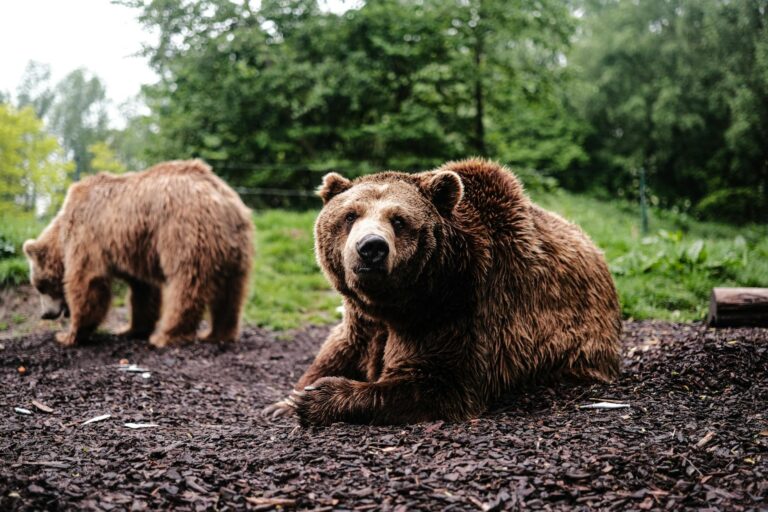
- Shoulder hump. Grizzlies and brown bears have a pronounced muscular hump above the shoulders. Black bears do not.
- Face profile. Black bears have a straight profile from forehead to nose. Grizzlies have a concave, dished-in profile and a wider head.
- Ears. Black bears have taller, more prominent ears. Grizzly ears look smaller relative to the head.
- Claws. Grizzly front claws are 5 to 10 cm (2 to 4 in) and visible from a distance. Black bear claws are shorter and curved for climbing.
- Rump. A grizzly’s rump sits lower than its shoulders. A black bear’s rump is higher than its shoulders.
Match to range
You are unlikely to meet a grizzly outside the western US (Montana, Wyoming, Idaho, Washington, Alaska), western Canada, or northern Eurasia. Polar bears live north of treeline: Arctic Canada, Alaska, Greenland, Svalbard, Russia. Black bears occupy the widest range in North America. If you are in the eastern US, the Appalachians, or northern Mexico, you are looking at a black bear.
For deeper species detail see our profiles of the American black bear, the grizzly bear, and the polar bear.
2. Bear behaviour: defensive vs predatory vs curious
Three categories. The response is different for each.
Defensive
A bear is defensive when you have surprised it, come between a sow and her cubs, or stumbled onto a carcass it is guarding. The bear wants you gone, not dead. Signs:
- Huffing, jaw popping, woofing.
- Ears flat, head low, back arched.
- Swatting the ground or false charging.
- Salivating.
Defensive bears almost always disengage if you back away calmly and give them space. Most grizzly encounters fall into this bucket. Playing dead is for defensive grizzly attacks, not predatory ones.
Predatory
A predatory bear is silent, persistent, and treats you like prey. It is rare with grizzlies, slightly less rare with black bears, and the default assumption for polar bears. Signs:
- Stalking from cover.
- Following you over distance.
- Ears forward, head up, intense focus.
- Approaching at night or entering a tent.
- Showing no alarm signals (no huffing, no jaw popping).
Fight a predatory bear. Do not play dead. The encounter only ends when you make the bear conclude you are not easy food.
Curious or habituated
Some bears, especially in heavily visited parks, have lost their natural wariness of people. They are not aggressive but they are not afraid either, and that is its own hazard. A habituated bear can flip to food-conditioned quickly if it gets a single meal of human food. We dig into this distinction in Food-Conditioned vs Habituated Bears.
3. What to do if you see a bear at a distance
Most sightings end here. The bear is across a meadow or down the trail, has not noticed you, or has noticed you and does not care.
- Stop. Do not get closer for a photo. Yellowstone’s minimum distance for bears is 100 yards (91 m), and that is a good floor anywhere.
- Watch the bear, not your phone. Track its direction of travel.
- Talk in a calm low voice so the bear knows you are human, not a prey animal.
- Detour widely around it. Give it the trail. Go back the way you came if the only path forward closes the distance.
- Do not approach cubs. A sow can cover ground faster than you can react. If you see cubs, the mother is close, even if you cannot see her.
- Group up. If you are in a party, bunch together, do not spread out. Larger groups look bigger and louder, and 91 percent of fatal black bear attacks between 1960 and 2009 were on parties of one or two people (Herrero et al., 2011).
4. What to do during an encounter, by species
Black bear encounter
Black bears are the species you are most likely to meet, and also the species most likely to be bluffing. They climb trees, they retreat when shouted at, and they are usually opportunists rather than aggressors.
- Stand tall. Wave arms above your head. Speak in a firm low voice.
- Do not run. A black bear can hit 48 km/h (30 mph). You cannot outrun one.
- Do not climb a tree. Black bears climb better than you do.
- Back away slowly, keeping the bear in view but not staring directly into its eyes.
- If it follows or huffs: stand your ground, get bigger, throw rocks or sticks at it. Have bear spray ready.
- If it attacks: fight. Aim for the muzzle and eyes. Do not play dead. Black bear attacks that become contact are almost always predatory, and submission invites further attack.
Brown bear / grizzly encounter
The same body language with one critical inversion: if a grizzly makes contact in a defensive attack, play dead.
- Speak softly. Do not shout. Do not look the bear directly in the eyes (a fixed stare reads as threat).
- Make yourself non-threatening. Move sideways, not toward the bear. Bear spray out and ready.
- If it bluff-charges: stand still. Most grizzly charges stop short. Running triggers chase instinct.
- When a charging bear is within about 18 metres (60 ft): deploy bear spray in a sustained 1 to 2 second blast aimed slightly down so the cloud rises into the bear’s face.
- If contact happens (defensive): drop face-down, spread legs to make it harder to flip you, lace hands behind your neck, keep your pack on as armour. Stay still until the bear leaves the area, not just stops attacking.
- If the attack continues, or the bear starts feeding or dragging you, it has shifted to predatory. Fight with everything you have. Aim for the face.
Polar bear encounter
The default assumption is predatory. Polar bears in the wild rarely see humans and they will not be intimidated by your size or voice the way other bears can be.
- Get to shelter immediately. Vehicle, building, boat. If you are on foot in the open, you are in trouble.
- Group tightly. Do not let the bear pick off a single member.
- Bear spray works on polar bears, but the cold and wind degrade the cloud faster than in temperate climates. Stay closer to your party.
- Firearms. In polar bear country (Svalbard, parts of Nunavut, Arctic Russia) a rifle is standard kit. Use noise deterrents such as bear bangers or flares first, if you are trained to.
- If attacked: fight. Do not play dead. Aim for the eyes and nose. The attack will not stop until the bear decides you are not worth the effort.
5. When to use bear spray (the data, not the folklore)
Bear spray is the single most effective tool for surviving a close-range bear encounter. A 2008 peer-reviewed study by Tom Smith and colleagues (published in the Journal of Wildlife Management) reviewed 83 bear-spray incidents in Alaska between 1985 and 2006 and found:
- 92% of close encounters with brown bears were stopped by bear spray.
- 90% with black bears.
- 100% with polar bears (small sample).
- 98% of people who used bear spray were uninjured by the bear.
A follow-up study comparing bear spray to firearms found that people who used bear spray were less likely to be injured than people who used a firearm, in part because firearms require accuracy under acute stress.
How to deploy bear spray
- Keep it accessible. Chest holster or hip. A canister inside your pack is useless.
- Remove the safety clip as the bear approaches.
- Start spraying when a charging bear is within about 18 metres (60 ft). Most cans throw an effective cloud 7 to 10 metres in still air, so the cloud is in place when the bear arrives.
- Aim slightly downward so the orange cloud rises into the bear’s face. Aiming at the head sends the cloud over the top.
- Spray in a 1 to 2 second burst. Do not empty the can in one panicked squeeze. You may need a second blast.
- In wind, account for drift. A strong tailwind helps; a headwind can blow the cloud back onto you. Move laterally if you can.
- After the bear retreats, leave the area. Bear spray is a deterrent, not a knockout. It does not injure the bear, and the bear may come back.
Range, shelf life, regulations
- Effective range: 7 to 10 m (25 to 35 ft) for most consumer brands.
- Shelf life: typically 3 to 4 years. Check the canister date and replace it. Old cans lose pressure.
- Air travel: bear spray is banned from carry-on bags, and standard canisters are too big for checked bags as well. FAA PackSafe rules allow one can of 118 ml (4 fl oz) or less in checked baggage if it meets the self-defense spray limits, international rules ban it, and most bear sprays are larger. Buy on arrival.
- Not legal everywhere. Several countries restrict capsaicin sprays. Check local rules before you fly.
6. Hiking, camping, food storage: prevention beats reaction
The best bear encounter is the one that never happens. Almost every serious incident traces back to one of three failures: surprise, food, or curiosity (theirs or ours).
Hiking
- Make noise. Talk, clap, sing at blind corners and dense brush. Bear bells are too quiet to be reliable. Your voice is better.
- Hike in groups of three or more in grizzly country.
- Stay on the trail. Off-trail travel through alders or willow at dusk is the highest-risk profile.
- Watch for sign. Fresh scat, claw-marked trees, dug-up roots, overturned logs. Reroute if the sign is hot.
- Avoid dawn and dusk when bears are most active. Plan for mid-morning and midday hiking.
- Do not run when startled. Even a fleeing deer can trigger a chase response.
- Carry bear spray on a chest holster, not inside a pack.
Camping
- Camp at least 100 metres (330 ft) from your cooking and food-storage area, in a triangle: tent, kitchen, food cache. This is the bear triangle Parks Canada and the NPS both recommend.
- Never eat in your tent. Food smells cling to tent fabric.
- Sleep in clothes you did not cook in.
- Pee away from camp. Not on it.
Food storage
- Use a certified bear canister in any backcountry without bear lockers. IGBC-approved (Interagency Grizzly Bear Committee) is the standard.
- In car camping, lock all food, coolers, scented toiletries, and trash inside a hard-sided vehicle. Bears open soft-top cars in seconds.
- Bear hangs (counterbalance method) work where canisters are not required, but a sloppy hang is worse than no hang. At least 4 metres (13 ft) up and 1.2 metres (4 ft) out from the trunk.
- What counts as scented: toothpaste, sunscreen, lip balm, deodorant, insect repellent, dirty dishwater, a granola wrapper in your pocket. All of it goes in the canister or vehicle.
A bear that gets a human-food reward becomes food-conditioned. Food-conditioned bears get killed. “A fed bear is a dead bear” is a rule for the bear’s sake as much as yours.
7. Bears in suburbs and backyards
The fastest-growing kind of bear encounter is not in the backcountry. It is in subdivisions on the wildland-urban edge, where black bears (and grizzlies in some western towns) raid trash cans, bird feeders, and chicken coops.
- Secure your trash. Bear-resistant bins, or stored in a hard-sided garage until pickup morning.
- Take down bird feeders from April through November in bear country. A 5 kg (10 lb) seed bag is a jackpot meal for a bear.
- Clean your barbecue. Grease traps and drip pans are bear magnets.
- Pick fruit promptly from backyard trees.
- Electric fencing is the gold standard for chicken coops, beehives, and small orchards in bear country.
- Never feed bears, even cubs, even once. This is the single biggest cause of food conditioning.
For the difference between a bear that has learned to ignore people (habituated) and a bear that has learned to seek out human food (food-conditioned), see our companion piece: Food-Conditioned vs Habituated Bears.
8. How rare bear attacks really are
The headlines distort the picture. The actual numbers are reassuring.
- From 1979 to 2023, grizzlies injured about 1 person per 3.6 million visits to Yellowstone National Park (Gunther and Atkins, Ursus, 2025).
- Bombieri and colleagues (Scientific Reports, 2019) counted 664 brown bear attacks on people worldwide between 2000 and 2015, across a species population of roughly 200,000 spread over North America, Europe and Asia.
- Fatal black bear attacks in North America averaged fewer than one per year between 1900 and 2009 (Herrero et al., Journal of Wildlife Management, 2011), against a continental population of several hundred thousand animals.
- Wilder and colleagues (Wildlife Society Bulletin, 2017) documented 73 polar bear attacks on people worldwide between 1870 and 2014, with the rate rising in the most recent decade as sea ice declines.
- Cause of death comparison. In the US, more people die each year from bee stings, lightning, and (by a wide margin) car accidents on the way to the trailhead than from bears.
For a deeper look at the patterns behind these numbers see our companion piece on bear attacks.
A useful frame: bears are not safe, but they are predictable. The risk of a bear encounter going badly drops sharply once you carry spray, hike in a group, store food properly, and know which species is in front of you.
9. Frequently asked questions
What should you do if you see a bear?
Stop, do not run, talk calmly so the bear knows you are human, and back away slowly while keeping the bear in view. If the bear has not noticed you and is at distance, detour around it and leave the area. Get bear spray in your hand if the bear is within 30 metres.
Black bear vs grizzly: how do you tell the difference?
Look for the shoulder hump (present on grizzlies, absent on black bears), the face profile (concave on grizzlies, straight on black bears), the rump height (lower than the shoulders on grizzlies, higher on black bears), and the claw length (long and visible on grizzlies). Coat colour is not reliable: black bears can be brown, blonde, or cinnamon.
Does playing dead work with all bears?
No. Play dead only for a defensive grizzly attack (a bear you have surprised, or a sow with cubs). For predatory attacks by any species, and for any attack by a black bear or polar bear, fight back. Aim for the muzzle and eyes. This follows US National Park Service advice. Parks Canada differs: it advises playing dead in any defensive attack that makes contact, whatever the species.
How effective is bear spray?
Peer-reviewed research (Smith et al., 2008) found bear spray stopped 92% of brown bear encounters, 90% of black bear encounters, and 100% of polar bear encounters in the study sample. People who used bear spray were less likely to be injured than people who used firearms in comparable encounters.
What time of day are bears most active?
Most bears are crepuscular: active at dawn and dusk. They also forage at night, especially in areas with high human traffic during the day. Mid-morning to early afternoon is the lowest-risk window for hiking. Polar bears do not follow this pattern and can be active around the clock during the Arctic summer.
Should you run from a bear?
No. Running triggers the bear’s chase instinct, and you cannot outrun any bear species. Black bears reach 48 km/h (30 mph), the fastest speed reliably recorded for a grizzly in Yellowstone is the same, and a polar bear can sprint at 40 km/h (25 mph) over short distances. Back away slowly instead.
Are bears more dangerous in spring or fall?
Both seasons carry elevated risk for different reasons. In spring, bears emerge from dens hungry and may be more aggressive around food, and sows are often with new cubs. In autumn (hyperphagia) bears are feeding around the clock to build winter fat reserves and can be less tolerant of disturbance. Summer carries the highest absolute risk simply because that is when humans share the most ground with bears.
Bear safety stories and guides
- Reducing Human-Bear Conflict: A Practical Guide
- This Is How Yosemite Bears Are Getting Smarter Due To Human Mistakes
- Using Dogs For Bear Management: Can It Work?
- Supplemental Bear Feeding: Does It Solve Or Cause More Problems?
- Lessons Learned From The Life And Death Of Timothy Treadwell: The Grizzly Man
- Two People Killed by a Grizzly Bear in Canada’s Park
- Rock Climber Fought Off Bear in Japan
- Group Taking Selfies with Bear Cubs in North Carolina
- Looking for Hank the Tank Bear in Lake Tahoe
- The Bear That Stole Candy From a 7-Eleven
- Man Shot a Bear Nine Times
Related reading
- Everything You Need to Know About Bear Attacks
- Food-Conditioned vs Habituated Bears
- Species Profile: American Black Bear
- Species Profile: Grizzly Bear
- Species Profile: Polar Bear
Updated 28 September 2026: corrected the bear spray distance to 60 ft, the polar bear deterrent advice, the group-size claim and updated the Yellowstone injury odds.




Ran into a black bear on a trail in Montana two summers back and it just walked off. the spray lives on my hip belt now, not in the lid pocket.
How do people judge 60 feet with a bear coming at them? I can barely judge it standing in a car park.