

Are Bears More Dangerous in Spring or Fall?
Last updated: November 5, 2026
8 min read
The honest answer is “both, for different reasons, and summer is statistically the worst of all three.” Spring bears are lean, hungry and often defending cubs. Autumn bears are in hyperphagia and willing to push harder for calories. Summer simply has the most humans on bear ground, which is why summer carries the highest absolute number of attacks. But spring and autumn each carry a distinct flavour of risk that changes how you hike, store food, and read bear behaviour. This piece breaks down each season, the biology behind it, and the actual attack data.
For the year-round playbook, the Bear Safety pillar is the starting point. For seasonal biology in depth, our American black bear profile, brown bear profile, and grizzly bear profile cover diet, activity, and den cycles by species.
The seasonal cycle in one paragraph
Bears in temperate North America follow a roughly predictable yearly cycle: hibernation from late October or November to March or April, emergence in April and May, peak activity through summer, hyperphagia from late August through October as bears pack on fat for the next winter, then back to the den. Where you sit on that cycle when you meet a bear changes the bear’s behaviour, its motivation, and its threshold for aggression.
That rhythm shapes almost everything a bear does. Our guide to bear behavior explains the wider picture.
Spring bears: the lean months
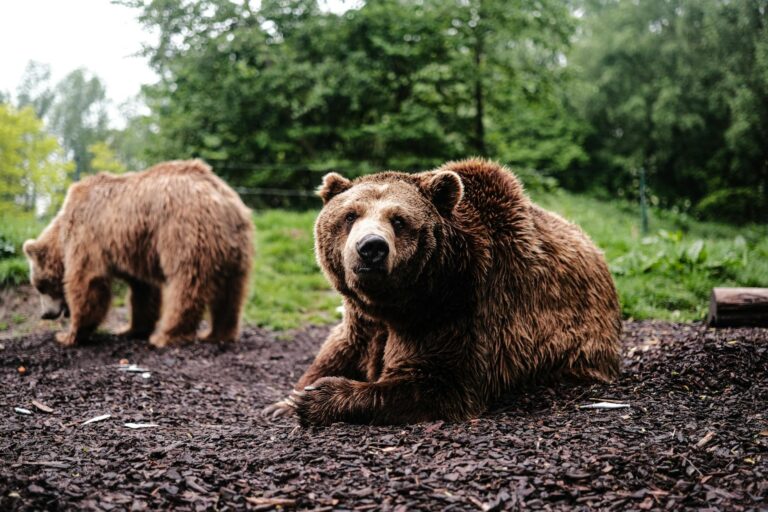
Photo by Stefan Maritz on Pexels
Bears come out of the den thin, into a landscape that has not yet greened up. Males emerge first; females with cubs of the year stay in longer. By April or early May the whole population is on the ground and looking for food.
Spring biology that affects safety:
- Calorie debt. Bears can lose up to a third of their body weight over the denning period. They are not starving in spring, but they are highly motivated to feed.
- Limited food. Berries and salmon are months away. Spring diets lean on winter-killed ungulates, early grasses, sedges, roots, and any human food a bear can find.
- Carrion defence. Winter-killed elk and deer are a primary spring calorie source. A bear on a carcass is in defensive mode, and a surprise encounter there is especially dangerous.
- Females with cubs. New cubs of the year come out of the den in March and April. A mother with cubs is the most dangerous configuration in bear country, and spring is when that configuration is most common.
- Sub-adult dispersal. Two and three-year-olds pushed out by their mothers are wandering unfamiliar ground in spring. Inexperienced bears make more mistakes around people.
What this means for hikers in April, May and early June:
- Be loud on blind corners. Surprise is the dominant attack trigger in spring.
- Watch for ravens, eagles and coyotes circling. They often sit on a carcass a spring bear is using.
- Treat any bear with cubs as a red encounter regardless of distance.
- Carry bear spray where you can reach it. Spray season is now.
Summer bears: the highest absolute attack count
Summer is when the statistics peak, and the reason is mostly people, not bears. Bombieri and colleagues, reviewing brown bear attacks worldwide, found that 48 percent of incidents happened in summer and 73 percent happened in daylight. Yellowstone records most of its bear-caused injuries between June and August, and the same pattern holds across Glacier, Banff, the North Cascades, and the bigger black bear states.
Summer drivers:
- Maximum visitor numbers on bear habitat. More hikers, more campers, more roadside encounters.
- Increased sub-adult activity. Yearlings and two-year-olds are mobile, learning, and frequently in trouble.
- Berry season ramps up. Huckleberry, buffaloberry and salmonberry pull bears into mid-elevation forest where hikers also concentrate.
- Daylight hours. Long northern days mean bears forage longer and at unexpected hours.
Summer is the season to nail every safety habit: noise, groups, spray, the camp triangle, no food in the tent. None of that is new in summer. It just matters more, because the encounter rate is higher.
Autumn bears: hyperphagia and the calorie hunt
By late August in the northern Rockies and Alaska, and by mid-September across most of temperate North America, bears enter hyperphagia. They feed for up to 20 hours out of 24 and can put on as much as four pounds of fat in a day. The arithmetic is brutal: a bear must arrive at the den with enough fat to survive a four to seven month shutdown.
- Caloric obsession. A hyperphagic bear is single-minded about food. It will defend a food source against larger bears, tolerate human presence it would otherwise avoid, and travel further between food patches.
- Berry crop variation. Bad berry years are bad for bears. In a poor year they move further down-mountain and turn to gardens, orchards, rubbish, livestock and beehives, and human-bear conflict rises accordingly.
- Salmon runs. On the Pacific coast, autumn salmon concentrate brown bears into dense, hierarchically organised feeding groups. The danger to humans on salmon streams is high. So is the danger to other bears.
- Den preparation. Bears dig dens in late September and October, and their daily movement patterns change as they scout sites.
What this means for autumn hikers:
- Berry patches are bear magnets. Extra noise, and go in a group.
- Watch for fresh diggings, claw-stripped trees, and scat full of berry seeds.
- The bear that tolerates you in May may not tolerate you in October.
- Late October risk is still real after the first snow. Most bears are not yet denned.
Real attack data by season
Bombieri and colleagues published a worldwide review of brown bear attacks in Scientific Reports in 2019, covering 2000 to 2015. What they found:
- 664 attacks worldwide across the 16-year window, an average of 39.6 a year, against a global brown bear population estimated at more than 200,000.
- Regionally: 11.4 attacks a year in North America, 18.2 in Europe, and 19 in the East.
- Seasonality: 48 percent of attacks happened in summer, and 73 percent happened in daylight.
- What the victims were doing: leisure activities accounted for 50 percent (hiking, berry and mushroom picking, camping, fishing, jogging), outdoor work 28 percent (farming, livestock guarding, logging, fieldwork), and hunting 22 percent.
- Nearly half of attacks, 47 percent, involved a defensive reaction from a female with cubs. And 88 percent of victims were adult males.
Herrero and colleagues reviewed fatal black bear attacks in North America from 1900 to 2009 in the Journal of Wildlife Management in 2011, finding 63 people killed in 59 incidents over the 110 years, fewer than one a year. Eighty-eight percent involved a bear behaving as a predator, and the great majority of those bears were male. Most fatal attacks happened in remote settings with a single victim, and fatal attacks peaked in August, when black bears feed hard before denning.
Wilder and colleagues reviewed polar bear attacks in the Wildlife Society Bulletin in 2017 and documented 73 attacks between 1870 and 2014, causing 20 deaths and 63 injuries. Attacks have risen as the ice-free season has lengthened, because nutritionally stressed bears spend more time ashore, where the people are.
Season-by-season comparison
Photo by Nicky Pe on Pexels
| Season | Dominant biology | Main risk profile | Practical advice |
|---|---|---|---|
| Spring (Apr to May) | Lean post-den, females with new cubs, carrion defence | Surprise on a carcass, defence of cubs | Loud on corners, scan for ravens, give cubs a huge berth |
| Summer (Jun to Aug) | Peak activity, peak visitors | Highest absolute attack count, mostly surprise and food conditioning | Standard safety toolkit, every day |
| Autumn (Sep to Oct) | Hyperphagia, calorie obsession | Lower tolerance, food defence, berry-patch overlaps | Avoid known berry patches alone, careful in low-berry years |
| Winter (Nov to Mar) | Most bears denned, but not all | Low overall, polar bears year-round | Polar bear country, and sub-Arctic black bears in mild winters |
Are spring bears really more aggressive than autumn bears?
You will often read that spring bears are grumpy because they are sleep-deprived. That part is folklore. Bears are not sleeping through hibernation, they are in a hypometabolic state, and they do not emerge short of sleep. But the underlying observation holds: spring bears do behave more erratically. The reasons are different ones:
- Caloric debt after winter
- A landscape that has changed since they denned
- Hormonal shifts, since the breeding season for males runs May into June
- Females protecting brand-new cubs
Autumn bears, by contrast, are well fed and physically peaking, and their aggression is calorie-defensive rather than reactive. A spring bear may bluff and leave. A hyperphagic autumn bear on a deer carcass is more likely to commit.
For a deeper look at the patterns behind the numbers see Everything You Need to Know About Bear Attacks, and for the bears most likely to cause problems in any season, Food-Conditioned vs Habituated Bears.
Practical takeaways
- Spring (April to early June): treat every bear as a potential mother with cubs. Stay loud, stay in groups, watch the trail for fresh carcasses and the sky for scavengers.
- Summer (June through August): highest absolute encounter rate. Run the full safety stack, spray on the hip, no surprises on blind corners, perfect food storage, no exceptions.
- Autumn (September and October): calorie-driven behaviour. Avoid berry patches alone, expect bears at lower elevations in poor berry years, treat carcasses and salmon streams as red zones.
- Year-round in polar bear country: different rules entirely. Polar bears do not follow the temperate cycle, and predatory attacks on humans are more common than with brown or black bears. See the polar bear species profile.
FAQ
Are bears more dangerous in spring or autumn?
Both carry elevated risk, for different reasons. Spring bears are lean and often defending new cubs, which raises the risk of a defensive attack. Autumn bears are in hyperphagia and will push harder for calories. Statistically, summer has the highest absolute attack count, because that is when humans share the most ground with bears.
What is hyperphagia in bears?
The autumn feeding frenzy, in which bears forage for up to 20 hours out of 24 and can gain as much as four pounds of fat a day, building the reserves they need to survive four to seven months of hibernation. It typically runs from late August through October.
How much weight do bears lose in hibernation?
Up to a third of their body weight over the den period, through fat metabolism. The exact loss depends on species, sex, reproductive status and den length. Nursing females lose the most, because they are feeding cubs at the same time.
When do bear cubs come out of the den?
In temperate North America, mothers with cubs of the year typically emerge in March or April, after the males have already left their dens. The cubs are born in the den in midwinter and are only weeks to a few months old when they first see daylight.
Are bear attacks more common in summer?
Yes, in absolute terms. Bombieri and colleagues found 48 percent of worldwide brown bear attacks happened in summer, and Yellowstone and most major US national parks record most of their bear-caused injuries between June and August. The reason is human visitor numbers, not heightened bear aggression. Per-encounter risk is high in spring and autumn too.
Related reading
- Bear Safety: How to Stay Safe Around Black, Brown, and Polar Bears
- Bear Attacks: Stats, Species, Safety, and Myths
- What to Do If You Encounter a Bear While Hiking
- Food-Conditioned vs Habituated Bears
- Species Profile: The American Black Bear
- Species Profile: The Brown Bear
- Species Profile: The Polar Bear
This article is part of our bear facts guide, which links every article on bear behaviour, safety and culture.
Updated 28 September 2026: corrected the black bear death count wording and the seasonal pattern, which peaks in August.



Spring is when I check the date on my spray canister, since it sits in the gear bin all winter. Does it lose pressure if the garage gets really cold?