

Bear Hibernation: How and Why Bears Hibernate
Last updated: November 16, 2026
7 min read
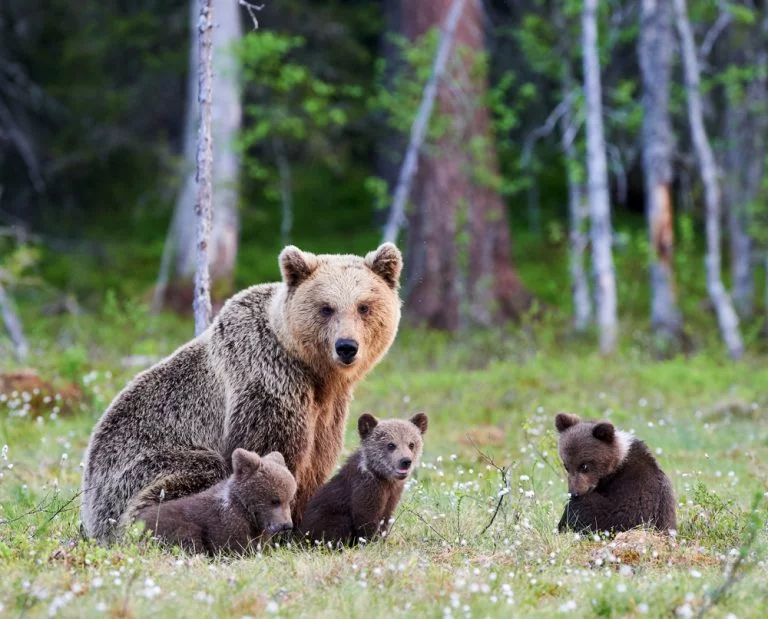
For half the year, a wild brown bear in interior Alaska may not eat, drink, urinate, or defecate. In hibernating black bears studied in Alaska, heart rate fell from about 55 beats per minute to as few as 9. Her body temperature falls only a few degrees, but her metabolism slumps to about a quarter of summer rates. Somewhere around January, in absolute darkness, she gives birth to cubs the size of squirrels and nurses them through the spring without ever stepping outside. When she finally emerges in April, gaunt but standing, she has performed one of the most extreme physiological feats in the mammal world.
Bear hibernation is strange even by hibernation standards, and the science of it has been quietly rewritten over the last 40 years. Here is what we now know about how and why bears do it, which bears actually do it, and why polar bears, of all things, mostly do not.
True hibernation vs torpor: an old argument
For decades, mammalogists argued that bears were not “true” hibernators. Ground squirrels and marmots drop their body temperature close to freezing and rouse only briefly every couple of weeks. Bears stay warmer (30 to 36 C, an average of about 5.5 C below normal, in one Alaska study) and can wake quickly if disturbed. By the strict thermal definition, bears were dismissed as merely entering “winter lethargy” or “torpor.”
That view has lost ground. Work led by Brian Barnes at the University of Alaska Fairbanks showed that black bears slash their metabolic rate by around 75 percent while holding body temperature close to normal. Small mammals cannot do that. They need the cold to suppress metabolism. Bears decouple the two. For this reason many biologists now call bears true hibernators, and Yellowstone National Park describes black bears that way. Others still use the older terms: Alaska Department of Fish and Game says brown bear denning is not true hibernation.
Bears pile on the fat reserves before denning, and the race to do so is what Fat Bear Week tracks every autumn.
The practical upshot for anyone watching a winter den: a bear in hibernation is not unconscious. A black bear roused in February can be on her feet in seconds. A ground squirrel takes hours.
Why do bears hibernate? Energy, not cold
Hibernation is a food problem, not a cold problem. The bears that hibernate longest live in places where winter food disappears for months: berries gone, salmon runs done, ungulate carrion buried under snow. A grizzly burning thousands of kilocalories a day on summer foraging cannot find that energy in a January spruce forest. So she shuts down.
The trigger is a mix of shortening day length, falling temperatures, and dwindling food. The preparation, called hyperphagia, can see an Alaska brown bear gain around 1.4 to 2.7 kg (3 to 6 lb) of fat a day in summer and autumn (NPS). Bear 480 Otis, the four-time Fat Bear Week champion at Brooks Falls in Katmai National Park, has been photographed transformed from a leggy spring bear into something that looks structurally different by October. He was not the same bear by November. Otis has not been seen at Brooks River since 2023.
Metabolic changes: the part that fascinates physicians
What happens inside a hibernating bear is, frankly, miraculous from a medical standpoint:
- No food, no water. Bears recycle metabolic water from fat oxidation and reabsorb water in the bladder. They do not drink for 5 to 7 months (Tøien et al. 2011).
- No urea poisoning. Most mammals would die from accumulated urea within weeks. Bears break urea down and recycle the nitrogen into amino acids, building protein from their own waste (NPS).
- No muscle wasting. A human on months of bed rest loses a large fraction of leg muscle strength. Healthy bears come out of the den without losing muscle mass (NPS). NASA has studied this for spaceflight.
- No osteoporosis. Despite total disuse, hibernating bears do not lose bone density (NPS). They maintain bone-building activity even while immobile. Researchers see this as a possible model for treating human osteoporosis.
- High cholesterol, no artery damage. In hibernating brown bears, total cholesterol ran about 40 percent higher than in summer, yet their arteries showed no atherosclerosis (Arinell et al. 2012).
Medicine is still mining bear hibernation for therapies it does not yet understand.
Den construction: the architect’s brief
Most bears dig their own dens, although the strategy varies by species and habitat. A typical American black bear den is dug into a hillside with a chamber barely larger than the bear herself, often lined with bark, leaves, or spruce boughs. Tight quarters are a feature, not a bug: less air volume to warm, less heat lost.
Brown bears and grizzlies often excavate dens at high elevation on north-facing slopes where snowpack arrives early and stays late. The snow forms an insulating dome above the den, holding temperatures inside near 0 C even when ambient air drops to minus 40 C. Kodiak bears on Alaska’s Kodiak Archipelago mostly dig their dens into steep slopes.
In the Cantabrian Mountains of Spain, a Cantabrian brown bear might use a natural rock cavity instead of digging, and her dormancy is shorter and shallower because winters are mild and oak mast can persist into December. Marsican brown bears in the Apennines, including the well-known female Amarena, who was shot dead outside Abruzzo National Park in August 2023, similarly use rock dens and may break dormancy on warm winter days.
Gestation and birth in the den
This is the part that still strains belief. A female brown bear breeds in late spring or early summer. Through a process called delayed implantation, the fertilised embryo floats free in her uterus for months and only implants in late autumn, after she has confirmed her fat reserves are sufficient. If she is too thin, implantation fails and she reabsorbs the embryos. The pregnancy itself, once implantation occurs, is around 8 weeks.
Cubs are born in the den in January or February, blind, nearly hairless, and tiny: roughly 450 grams in brown bears and about 500 to 600 grams in polar bears, against a mother who may weigh several hundred kilograms. She is in deep hibernation, yet she rouses enough to clean, position, and nurse them. Polar bear milk is among the richest of any terrestrial mammal, up to about a third fat, and the cubs multiply their birth weight several times over before the mother ever leaves the den.
Emergence: the slow climb back
Bears do not snap out of hibernation. The process of “walking hibernation” lasts up to about 3 weeks after emergence (Tøien et al. 2011), during which the bear’s metabolism, thermoregulation, and gut microbiome ramp back up. Bears emerge thin (often having lost up to a third of their body weight, NPS), wobbly, and not yet feeding heavily. Spring grasses, winter-killed carrion, and overwintered berries are the first foods. Salmon and ungulate calves come weeks later.
This is the hungriest, most dangerous time of year for bear-human encounters in places like the Greater Yellowstone Ecosystem. For nearly three decades the emblem of that spring emergence was Grizzly 399, born in 1996, who reappeared each year in Grand Teton with a new set of cubs and drew crowds every time. She was killed on 22 October 2024, struck by a vehicle on Highway 26/89 in Snake River Canyon, south of Jackson and outside the park boundary, at the age of 28.
Which bears actually hibernate?
Not all of them, and the answer is more nuanced than most field guides suggest.
| Species | Hibernates? | Notes |
|---|---|---|
| American black bear | Yes | Up to 7 or 8 months in the far north (ADF&G); shorter in the south |
| Brown bear / grizzly | Yes | 5 to 8 months in the coldest parts of Alaska (NPS) |
| Kodiak bear | Yes | Late October to April for males, to June for mothers with new cubs; some males stay active all winter (ADF&G) |
| Cantabrian brown bear | Light dormancy | Often broken; some males skip entirely in mild years |
| Marsican brown bear | Light dormancy | Variable, abbreviated |
| Asian black bear | Yes (northern) | Northern populations hibernate; southern do not |
| Polar bear | Pregnant females only | See below |
| Sun bear | No | Tropical, year-round food |
| Sloth bear | No | Tropical, year-round food |
| Spectacled bear | No | Andean, mild year round |
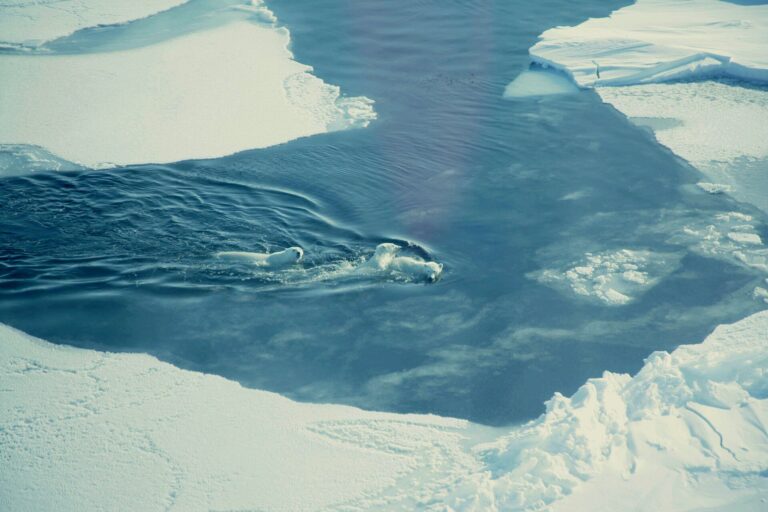
Polar bears are the great surprise. Adult males and non-pregnant females remain active through the Arctic winter, hunting ringed seals on the sea ice. Only pregnant females enter maternity dens, often dug into snowdrifts on land, where they give birth and nurse, usually from October or November until March or April. The rest of the population does the opposite of hibernation: they are most active when food is most available, which on the sea ice is winter and early spring.
Tropical species like the sun bear, sloth bear, and spectacled bear never hibernate. Their habitats provide year-round food. Sun bears, in particular, will forage at any hour and have no obvious annual rhythm beyond local fruiting cycles.
FAQ
Do bears wake up during hibernation?
Yes. Unlike small mammals, bears in hibernation can rouse within minutes if disturbed. Females also rouse to give birth and nurse cubs. On warm winter days, bears in mild climates (Cantabrian, Marsican, southern Appalachian) may leave the den briefly to feed before returning to dormancy.
How long do bears hibernate?
Up to seven or eight months in the far north, depending on species and latitude (ADF&G). A black bear in northern Ontario may den from October through April. A black bear in Florida may not hibernate at all. Pregnant polar bears stay in maternity dens for about four to five months. Tropical bears (sun, sloth, spectacled) never hibernate.
Why don’t polar bears hibernate?
Because winter is their best hunting season. Polar bears specialise in eating ringed seals, which are most accessible on Arctic sea ice from late winter into spring. Adult males and non-pregnant females stay active and hunting all winter. Only pregnant females enter maternity dens to give birth and nurse cubs.
How can a bear go months without urinating?
Bears recycle urea, the nitrogen waste that normally requires urination, by breaking it down and rebuilding muscle protein from it. Water is reabsorbed from the bladder back into circulation. Researchers are studying the underlying biochemistry as a potential treatment for human kidney failure.
For more on how bears prepare, signal, and survive the cold, see our bear behavior pillar. For winter-bear safety in regions where bears may emerge or remain partially active, see our bear safety guide. And for a primer on which species hibernate where, our overview of the eight bear species is the place to start.
Updated 28 September 2026: corrected the species in the heart rate study, polar bear denning times and Kodiak den sites, and updated the Otis section.
Updated 16 November 2026: linked the studies behind each figure and corrected the body temperature, cholesterol and den length figures.


I’d always pictured polar bears as the champion hibernators, being the cold-weather ones. Turns out it’s only the pregnant females, and the rest are out hunting.
My dad was in a hospital bed for six weeks last year and could barely stand afterwards. Hard to get my head round a bear lying still for five months and walking out more or less fine.