Bear Teeth: What 42 Teeth Say About Diet and Age
4 min read
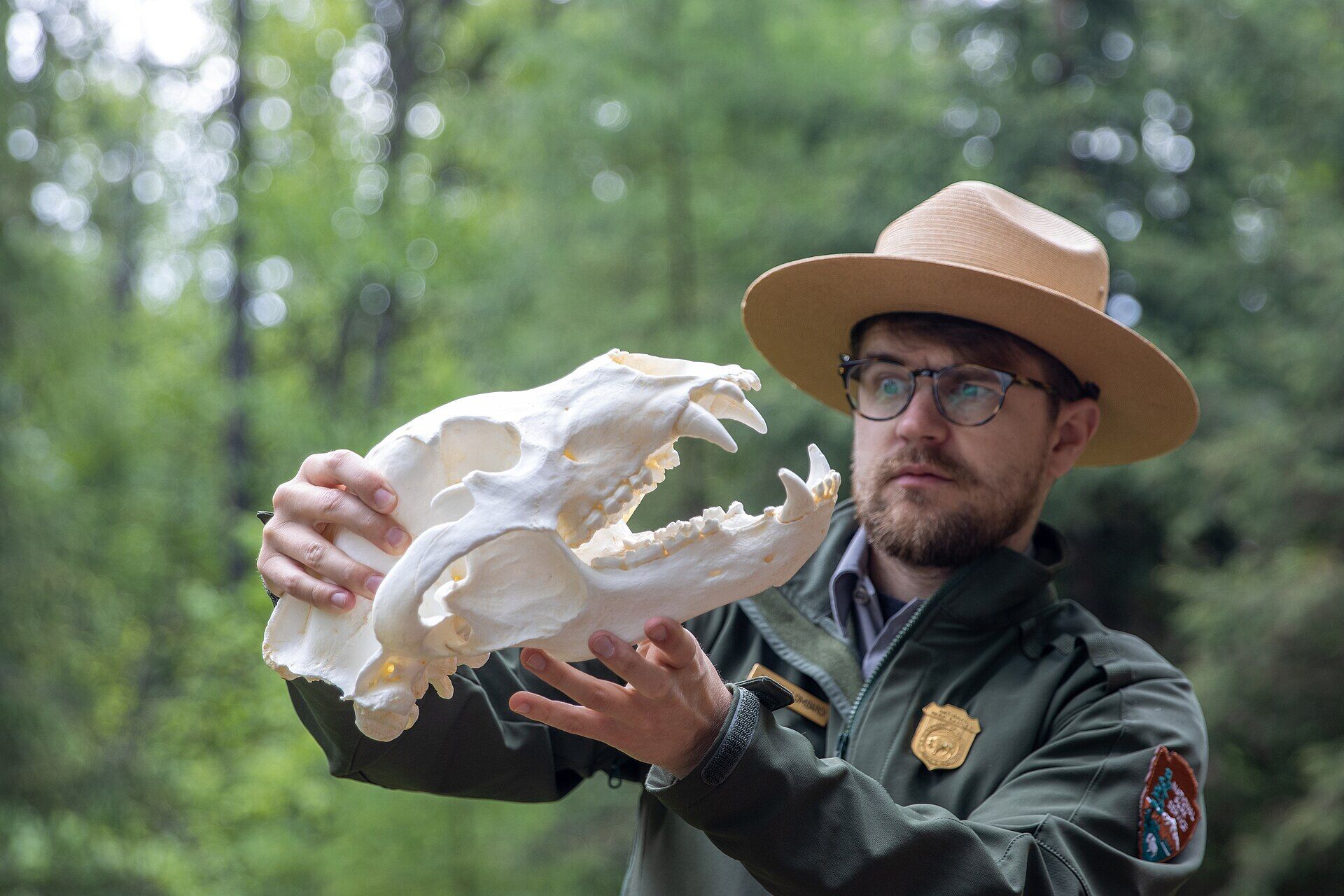
A brown bear’s mouth holds 42 teeth. The International Association for Bear Research and Management gives the dental formula as I 3/3, C 1/1, P 4/4, M 2/3, which means three incisors, one canine, four premolars and two or three molars on each side, top and bottom. That is the same count as a dog’s mouth, yet a bear uses the set very differently.
The teeth tell you what a bear eats, how it fights, and, once a biologist slices one open, how old it is.
The same tools, shaped for a mixed diet
Bears descend from meat-eaters, but most species now eat far more plants than meat. Their teeth show it. The general bear overview notes that the canines are large but mostly used for display, and that the molars are flat and crushing. Bears also have relatively undeveloped carnassials, the shearing teeth that cats and dogs use to slice meat like scissors.
A flat molar is a grinding tool. It suits roots, grasses, berries, nuts and the husks of insects. The long canines still matter when a bear grabs a fish or tears into a carcass, but they are not the main eating equipment.
The IBA page on brown bears adds a limit worth knowing: they are unable to break open large bones. The jaws are strong, yet they are built for a varied menu. For what that menu looks like through the year, see our guide to what bears eat.
The polar bear leans toward meat
The polar bear sits at the carnivore end of the family. Its teeth are described as sharper and more adapted to cutting meat: longer, sharper, more widely spaced canines and smaller, more pointed cheek teeth than a brown bear has. There is also a gap, called a diastema, between the canines and the cheek teeth, which may help the bear bite into prey.
Two close relatives, two sets of teeth, and the difference tracks the diet. A polar bear lives mostly on seals. A brown bear might spend a week on salmon and the next on sedges.
Specialists: the sloth bear and the giant panda
The sloth bear shows how far the pattern can bend. The IBA lists its feeding adaptations as reduced upper incisors and long digging claws, along with lips that can be protruded. With a gap at the front of the mouth and those flexible lips, the bear can suck termites and ants out of a nest. The cost is wear. A Wikipedia species account says adult sloth bear teeth are usually in poor condition, because of the soil they suck up and chew while feeding on insects.
The giant panda went the other way and built a bamboo cracker. The IBA says pandas have large skulls with wide jawbones and powerful jaw muscles, which let them crush tough bamboo stems. The broader bear skull is massive for the same reason: it anchors the large masseter and temporal muscles that close the jaw.
Teeth as a record of age
Teeth do not only cut and grind. They keep a diary. A bear lays down a thin layer of tissue called cementum around the root of each tooth, and the layers, called annuli, can be counted much like tree rings.
Wildlife agencies use this routinely. The Wyoming Game and Fish Department handbook says aging from cementum rings is more accurate than judging tooth wear, but it requires extracting a tooth for laboratory processing. It calls cementum the preferred method for aging bears. For black and grizzly bears it recommends the upper premolars, because the roots of many lower premolars break in the socket and spoil the count. It also notes that black bears have a complete, permanent set of teeth by two years of age.
How good is the method? A 1998 Pennsylvania study in the Journal of Wildlife Management tested 671 teeth from 521 black bears of known age. Overall, 8.1 percent of the teeth were aged incorrectly. The authors concluded that counting cementum annuli is a valid technique for aging Pennsylvania black bears. That is good, not perfect, and it explains why researchers quote ages with some care.
What this means for bears that lose teeth
Because a bear’s teeth are a working set, damage matters. Our profile of Bear 480 Otis mentions that by 2021 he was missing two of his canine teeth, and he still won Fat Bear Week that year. Tooth damage does not always stop a bear from feeding.
The reverse also holds. Rescued bile-farm bears often arrive with broken or badly decayed teeth, as Animals Asia reports, and vets sometimes have to pull them. You can read about sanctuary rescue work in our piece on Free The Bears.
What we do not know
The sources above give the dental formula for brown bears, and they note that the count varies between and within species. They do not give one tidy tooth count for every species, so we have not made one up. If you need an exact count for a particular bear, a skull measurement or a museum record is the better place to look.
Have you seen a bear skull in a park visitor centre, or handled one in a class? Email us at hello@lovebears.org and tell us what you noticed.
Sources
- International Association for Bear Research and Management: Brown bear
- International Association for Bear Research and Management: Sloth bear
- International Association for Bear Research and Management: Giant panda
- Wyoming Game and Fish Department: Aging techniques
- Harshyne et al. 1998, Journal of Wildlife Management
- Wikipedia: Bear
- Wikipedia: Polar bear
- Wikipedia: Sloth bear
- Animals Asia: Rescued moon bear Precious free of pain after dental surgery
Photo: Glacier National Park (NPS), Public domain, via commons.wikimedia.org.
This article is part of our bear facts guide, which links every article on bear behaviour, safety and culture.