
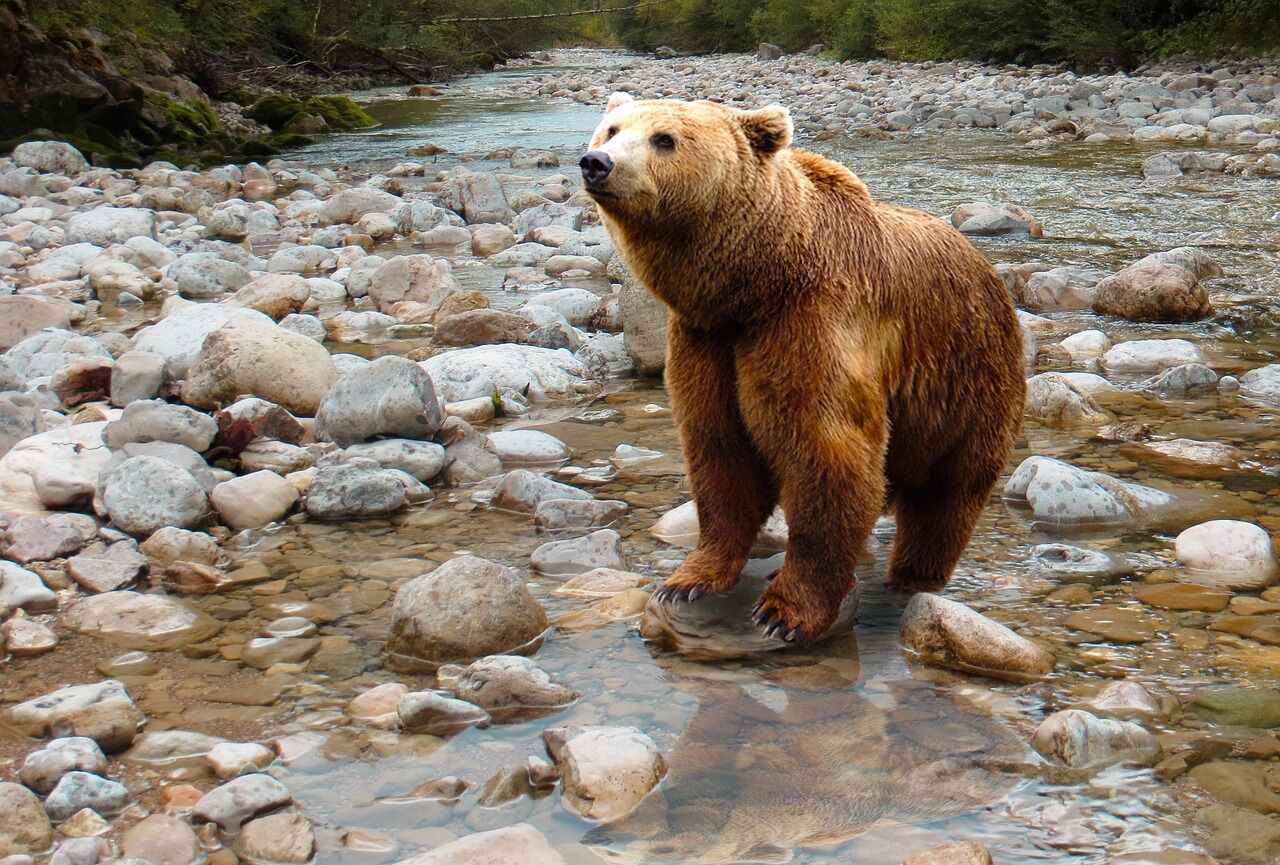
How Smart Are Bears? Intelligence, Memory, and Problem-Solving
Last updated: November 1, 2026
4 min read
Bear intelligence is one of those subjects where the anecdotes badly outrun the evidence. Anyone who has spent time around bears will tell you they are clever. Getting that into a form a scientist will sign off on is harder, and the published record is thinner than the internet suggests. Here is what we can actually point at.
Start with the smell
Bears have an enormous olfactory apparatus, and it shapes how they experience the world. A bear crossing a forest is not mainly looking at terrain. It is reading a layered chemical record with timestamps on it: what passed through, how long ago, whether it was carrying food.
That matters for the intelligence question because so much of what looks like bear cleverness is really memory for productive places, and smell is how those places get filed. A bear that returns to a berry patch that fruited well two autumns ago is not doing a party trick. It is using the sense it has most of.
You will see claims that bears have the largest brain relative to body size of any carnivore, or that they rival great apes. We have not found a source solid enough to repeat that, so we are leaving it out.
Tool use, and what was really observed
The cleanest published case is small and specific. In 2012 Volker Deecke reported in the journal Animal Cognition that a young wild brown bear in southeastern Alaska repeatedly picked up barnacle-encrusted rocks in shallow water, turned and re-oriented them in its forepaws, and used them to rub its neck and muzzle. His reading was that the bear was dealing with skin irritation or getting food residue out of its fur.
One bear, one behaviour, carefully described. That is what the tool-use literature on bears mostly looks like. There are also reports of polar bears throwing rocks and heavy chunks of ice at walruses. Beyond that, the field thins out fast.
Can bears count? The answer is properly messy
In 2012 Jennifer Vonk and Michael Beran published a study in Animal Behaviour testing three American black bears on a touchscreen, asking them to choose between arrays of dots. The title, “Bears ‘count’ too”, is usually where popular write-ups stop.
The results are more interesting than that. The researchers trained one bear to pick the larger array and two to pick the smaller one. All three performed above chance, including trials where the larger array covered less area. All three found moving dots harder than static ones, and one bear still managed to discriminate numerically larger moving arrays. So the bears clearly perceived quantity and acted on it.
Vonk’s group went on to test American black bears alongside humans and western lowland gorillas for the spatial-numerical association that makes people respond faster to larger numbers on one side of space. Small samples, careful claims. That is the honest shape of bear cognition research: a handful of captive animals, tightly designed tasks, and conclusions considerably more cautious than the headlines.
Food-conditioned bears are the field’s grim experiment
The strongest everyday evidence for bear problem-solving comes from places where it has become a management crisis. Bears that learn to associate humans with calories work at the problem with real persistence, because the payoff is enormous and the cost of failing is one wasted evening. Storage containers, latches, vehicle doors, bins: the design history of bear-resistant equipment is a record of bears defeating the previous version.
The sobering part is how durable the conditioning is. Hazing, relocation and aversive conditioning rarely undo it. That is why the modern emphasis in bear country has shifted to changing human behaviour rather than bear behaviour. It is easier to secure a bin than to un-teach a bear.
Navigation and mental maps
Bears hold detailed spatial knowledge of very large areas. The clearest demonstrations come from translocations: a problem bear is moved a long way from its home range, collared, and released, and a great many of them come back, often by direct routes rather than by searching. Exactly how they do it is unsettled. Olfactory cues, celestial cues and magnetic sensing have all been proposed, and none of them is nailed down.
Learning from mother
The most visible learning in bears is what passes from a sow to her cubs: which slopes to dig, which streams are worth the walk, which structures near people to avoid or to raid. Cubs spend one and a half to three years with their mother before they go it alone.
Brooks Falls in Katmai is where you can watch this happen. Bears there use distinct fishing techniques: standing on the lip of the falls to catch salmon in mid-air, snorkelling in the plunge pool, or chasing fish down in the shallows. Each one takes a different posture and a different set of timings, and they persist in individual bears across seasons. Whether the technique is learned from the mother, from watching other bears, or worked out independently is not something the cams can settle, and we should not pretend otherwise. Bear 480 Otis and his patient plunge-pool style is the best-known example.
FAQ
Are bears smarter than dogs? Nobody has run the comparison properly, so anyone answering confidently is guessing. The two have been studied for different things: dogs extensively on social and human-directed cognition, bears in a small number of captive studies on quantity and problem-solving. The tasks are not equivalent, so the scores are not comparable.
Do bears recognise individual humans? Field researchers who work with habituated bears consistently report that they do, mostly by smell. Lynn Rogers spent decades walking with wild black bears in Minnesota and described exactly this. It is well attested observation rather than controlled experiment.
How long do bears remember food sources? Years. Returning to productive patches across seasons is one of the most consistently documented things bears do.
Can bears count? They can distinguish quantities and act on the difference. Whether that is counting depends on how strict your definition is, and in the best-known study, captive black bears picked the larger or smaller set of dots, as trained, well above chance.
For more on how bears signal to each other, see our guide to how bears communicate. For the winter shutdown, see bear hibernation. For the wider picture, see our bear behavior pillar and our overview of the eight bear species.
Updated 28 September 2026: corrected how the black bear counting study was designed.





How far does a bear have to be moved before it stops coming back? I have read about relocated bears turning up at the same campground and always assumed it was luck.
Our dog learned to open the back gate latch in about a week, so I believe the bit about bins. Is there any evidence of one bear watching another open a container and copying it?
Not that I’ve found in a form I’d trust. Cubs clearly pick it up from their mothers, which fits what we know about learning from the sow, but copying between unrelated adults is mostly anecdote so far.