
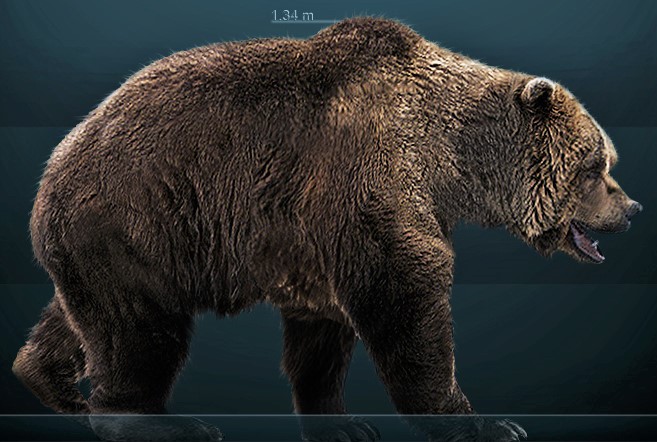
Giant Prehistoric Bears: The Largest Extinct Bears Ever
Last updated: November 5, 2026
4 min read
Modern bears are big. Prehistoric bears were absurd. The South American giant short-faced bear, Arctotherium angustidens, is the heaviest bear in the fossil record, and standing on its hind legs it would have looked into a second-floor window. For the eight species still alive, see our types of bears guide.
For scale: the largest wild Kodiak bear on record weighed around 750 kg. That is a giant by any modern standard, and several Pleistocene bears more than doubled it.
The largest extinct bears
1. Arctotherium angustidens, the South American giant short-faced bear
The current title holder. A specimen described in 2011 from La Plata, Argentina, was estimated at 1,588 to 1,749 kg. Arctotherium belongs to the same short-faced lineage as the North American Arctodus, on a larger scale. It was an Early to Middle Pleistocene animal and disappeared around 700,000 years ago. Why is not settled; competition with other large carnivores as the South American food web reorganised is the usual suggestion. Later, smaller Arctotherium species persisted much longer.
2. Arctodus simus, the North American giant short-faced bear
Arctodus simus ranged across North America from Alaska to Mexico in the Late Pleistocene. It stood roughly 3.4 metres on its hind legs and reached around 1,000 kg, with long limbs that suggest it covered ground quickly. Whether it hunted actively or made its living bullying other carnivores off their kills is still argued over. It went out in the end-Pleistocene extinctions, about 11,000 years ago.
3. Ursus spelaeus, the European cave bear
Cave bears occupied Europe and parts of western Asia from roughly 300,000 to 24,000 years ago. Adult males are generally estimated in the 350 to 600 kg range, with the largest individuals heavier still, and they carried a far more robust skull than a brown bear, adapted to chewing plant material. Their bones turn up in dense concentrations in caves from northern Spain to Romania, often in the same sites as Neanderthal and early modern human remains. Cave bear DNA has been recovered and sequenced.
4. Agriotherium
A wide-ranging genus that lived from the Miocene into the early Pleistocene across Africa, Eurasia and North America. Agriotherium africanum, from South Africa, is estimated at around 900 kg. Its anatomy suggests an opportunistic omnivore, closer in habit to a modern brown bear than to a specialist predator.
5. Indarctos
A Late Miocene bear known from Eurasia and North America. The largest specimens reached around 350 to 450 kg. Its teeth show adaptations to a more herbivorous diet, an early version of the dietary flexibility that defines modern bears.
6. Ursus deningeri, Deninger’s bear
The direct ancestor of the cave bear, in Europe from roughly 1.8 million to 100,000 years ago, and slightly smaller. It is one of the clearest cases of evolutionary continuity in the bear family: skull shape and tooth wear shift gradually towards the herbivorous cave bear across hundreds of thousands of years.
Why they got so big
The food supply allowed it. Pleistocene South America had ground sloths the size of cars, glyptodonts, and enough large herbivores to support predators with extreme size demands.
Cave bears got there by a different route. They were largely herbivorous, and their size came from low predator pressure and abundant winter denning space rather than from meat.
Why none of them survived
Two pressures stand out for the late Pleistocene giants:
- Loss of large prey. The extinction of mammoths, mastodons, ground sloths and giant bison around 11,000 years ago removed the calorie base the biggest bears depended on.
- Humans. Modern humans spread across Eurasia and the Americas in the same window. Cave bear remains cluster near sites of early modern human occupation, and the species disappears from the European record by about 24,000 years ago, some 20,000 years after modern humans arrived.
Smaller, more flexible lineages came through. Ursus minimus, a bear no bigger than a sun bear, sits near the base of the genus Ursus that most living bears belong to. Brown bears and Asian black bears can switch between berries, salmon, ungulates and human rubbish. The giants could not.
How modern bears compare
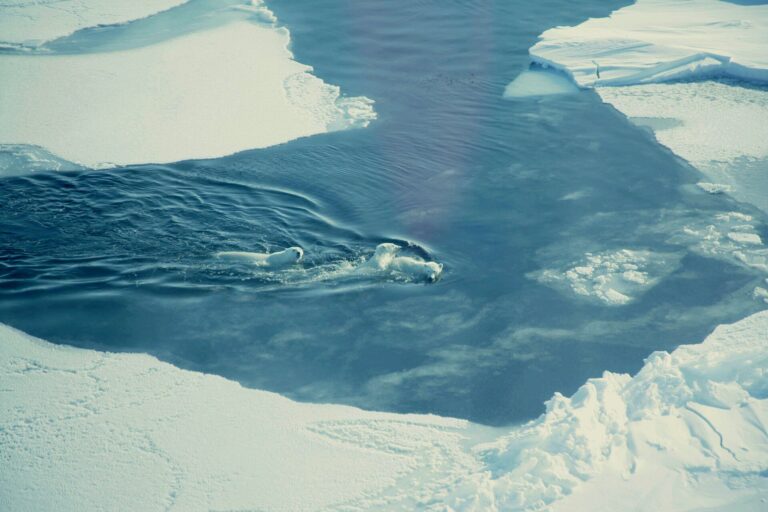
- Polar bear: large males reach about 700 kg; the record is 1,002 kg. See our polar bear profile.
- Kodiak bear: around 750 kg for the largest on record.
- Brown bear generally: 92 to 357 kg.
- Arctotherium angustidens: up to 1,749 kg, about 1.7 times the heaviest polar bear on record.
Frequently asked questions
What was the biggest bear ever?
Arctotherium angustidens, the South American giant short-faced bear. The largest known specimen is estimated at up to 1,749 kg. It went extinct around 700,000 years ago.
Were prehistoric bears carnivores?
Some were, some were not. The giant short-faced bears were most likely carnivore-scavengers. The European cave bear, despite its size, was mostly herbivorous on the tooth wear evidence.
When did the giant short-faced bear go extinct?
The North American Arctodus simus disappeared around 11,000 years ago, alongside the mammoths and other megafauna. The larger South American Arctotherium angustidens went much earlier, around 700,000 years ago.
Did cave bears live with humans?
Yes. Ursus spelaeus overlapped with Neanderthals and early modern humans in Europe for tens of thousands of years. Both used the same caves at different times, and cut marks on cave bear bones point to occasional hunting.
Are there any giant bears alive today?
No. Nothing living approaches Arctotherium or Arctodus. The polar bear is the closest in raw size, and even the largest recorded polar bears would have looked small next to the South American giant.
Related reading
Updated 28 September 2026: corrected the modern polar bear weights and the timing of the cave bear’s extinction.

The image of a bear looking into a second-floor window is going to stay with me. Did Arctodus overlap with the first people in North America, or was it gone before they arrived?
The cave bear being mostly a plant eater surprised me. An animal that size living on plants must have spent most of its waking hours chewing.
My son is deep in a fossil phase and we stood under a cave bear skeleton at a natural history museum last summer. His question, which I could not answer: how does anyone work out the weight of an animal from bones alone?