
Spectacled Bear Profile: Facts, Diet & Habitat Guide
Last updated: November 16, 2026
5 min read
The spectacled bear (Tremarctos ornatus), also known as the Andean bear, is the only bear species native to South America and the last surviving member of the short-faced bear subfamily Tremarctinae. Compact, tree-living and overwhelmingly vegetarian, it is the model for the fictional Paddington Bear.
Key facts at a glance
| Scientific name | Tremarctos ornatus |
| Family | Ursidae, subfamily Tremarctinae (own genus Tremarctos) |
| Length (head and body) | 1.2 to 2.0 m (4 to 6.5 ft) |
| Weight | Males 100 to 200 kg (220 to 440 lb), averaging about 115 kg; females 35 to 82 kg (77 to 181 lb), averaging about 65 kg |
| IUCN Red List status | Vulnerable, population decreasing |
| Lifespan | Commonly over 20 years in the wild; the captive record is nearly 38 years |
| Range | Andes from Venezuela south to Bolivia |
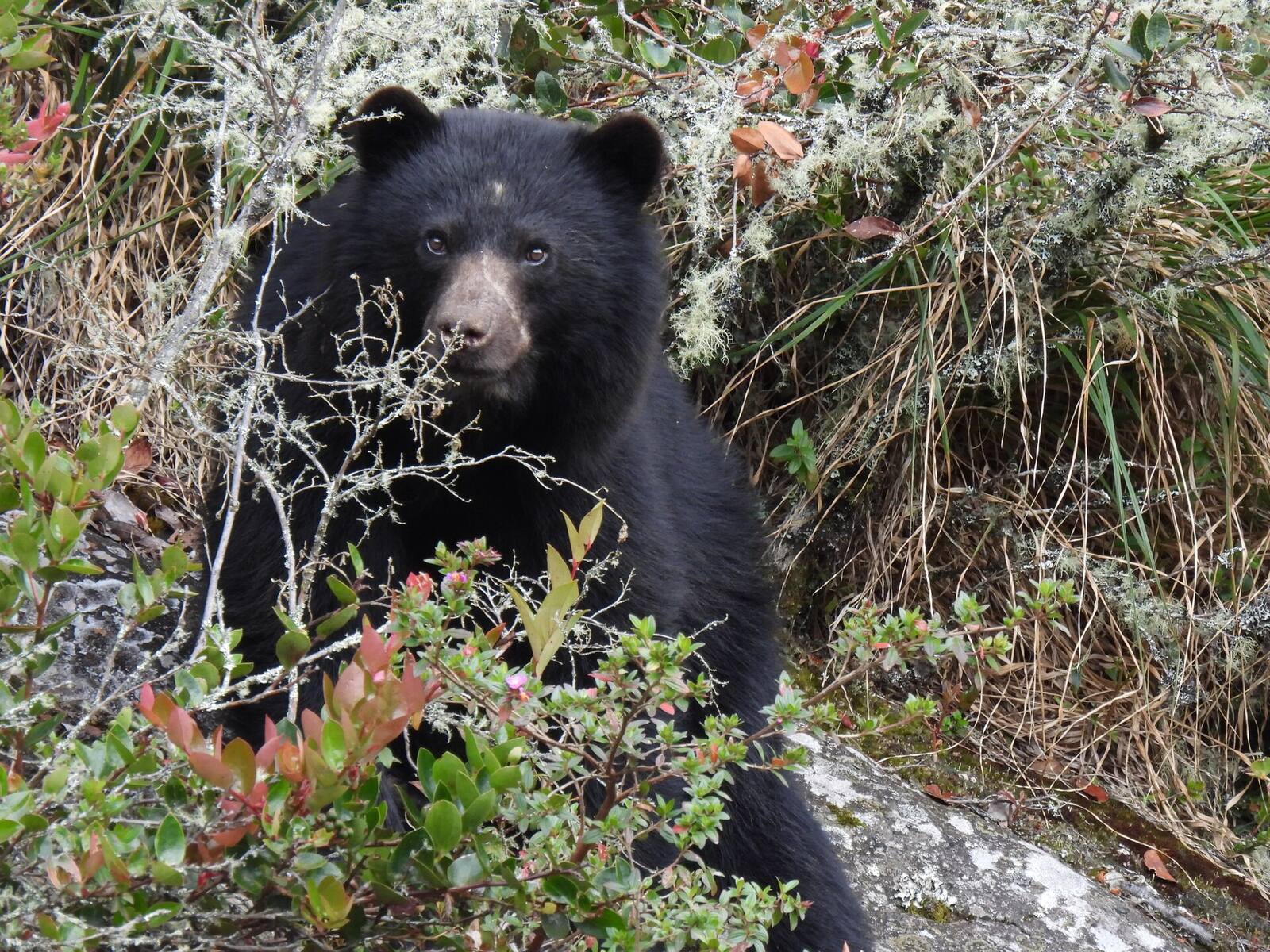
The species takes its English name from the pale, ring-like facial markings that resemble spectacles, although these vary between individuals and some bears have none at all.
What makes a spectacled bear a spectacled bear
Spectacled bears are short-faced, with a rounded skull, broad muzzle and heavy jaw musculature adapted for chewing tough vegetation. The coat is generally black, occasionally dark brown or reddish, with pale markings extending around the eyes, across the cheeks and onto the chest in many individuals.
They are heavily built for their size, with long, strong forelimbs and shorter hind limbs, which suits climbing more than running. This is one of the most arboreal of the large bears: adults regularly climb tall trees and build platform nests of broken branches in the canopy for resting and storing fruit.
Range and habitat
Spectacled bears are restricted to the Andes, occurring from Venezuela through Colombia, Ecuador, Peru and Bolivia.
They typically live between about 1,000 and 2,700 m, but the altitudinal range is unusually wide: they descend to around 200 m in coastal dry forest and have been recorded as high as 4,750 m. Humid montane cloud forest is the core habitat, where reliable fruit, bromeliads and dense cover overlap. In dry coastal Peru, smaller populations live in scrub desert and dry forest, using cactus and rocky outcrops for cover.
Diet and foraging
The spectacled bear is one of the most herbivorous bears alive. Only about 5 to 7 percent of the diet is meat. The rest is plant matter: fruit, bromeliads, palm hearts, bamboo shoots, orchid bulbs, the unopened young leaves of palms, cactus fruit and the inner bark of trees.
Animal protein comes mostly from ants, termites and bee brood, with occasional rabbits, mice and small ungulates when the opportunity arises. Mature males can take adult deer, llama and cattle, but this is unusual. Crops, sugar cane and honey are taken where available, which is the main source of conflict with farmers.
Reproduction and lifecycle
Unlike most bears, spectacled bears can mate at almost any time of year, though activity peaks as the rainy season begins and fruiting is at its heaviest. Pairs stay together for one to two weeks. Gestation runs around 5.5 to 8.5 months, with cubs born in the dry season.
Litters average two cubs, with one to three typical and four rare. Each weighs roughly 300 to 330 grams at birth. Cubs stay with their mother for around a year, then disperse. Sexual maturity comes at four to seven years.
Behaviour
Spectacled bears are largely solitary but notably vocal, using a soft repetitive contact call, a sharp alarm bark, and various chuffs and growls.
They are predominantly diurnal in undisturbed cloud forest and become more crepuscular and nocturnal where humans are common. They are exceptional climbers, often reaching the canopy in seconds, and build feeding platforms in mid and upper-storey branches that double as resting spots and food caches.
Are spectacled bears dangerous to humans?
Barely. Spectacled bears are among the shyest of the large bears and attacks on people are very rare. The species typically retreats up the nearest tree at any sign of people.
The conflict is overwhelmingly economic: bears raiding sugar cane and maize, or being blamed, often wrongly, for livestock losses. The major threat to the bear is, and has always been, people.
Conservation status and threats
The IUCN classifies the spectacled bear as Vulnerable with a declining population. Range-wide numbers are genuinely uncertain and published estimates vary by an order of magnitude, because the animal is shy, arboreal and lives in steep cloud forest that is difficult to survey. What is not in doubt is the habitat trend: in Ecuador alone, roughly 40 percent of the bear’s original distribution has been lost.
Other pressures include retaliatory killing by farmers, poaching for the gall bladder, and road mortality. The Andean Bear Conservation Project and various national park authorities continue to map populations and work on coexistence schemes. For wider context, see Bear Conservation.
Surprising spectacled bear facts
- It is the only bear species native to South America and the last living member of the Tremarctinae, the short-faced bear subfamily.
- Its nearest relatives are all extinct, including the South American short-faced bears (Arctotherium) and the Florida spectacled bear.
- It is the model for Paddington Bear, the fictional character originally said to come from “darkest Peru”.
- Spectacled bears build platforms of broken branches high in trees, to rest, store food and stay out of view.
- Only about 5 to 7 percent of the diet is meat, making it among the most herbivorous of all bears alongside the giant panda.
- The species name ornatus means “decorated” in Latin, after the pale facial markings.
Spectacled bear FAQ
Where do spectacled bears live?
Is the spectacled bear endangered?
Is Paddington Bear a spectacled bear?
What do spectacled bears eat?
Are spectacled bears dangerous?
Related reading
If you found this profile useful, the following guides go deeper on bears, conservation and safety. And if this species has caught your imagination, our roundup of bear gifts for bear lovers has picks that celebrate them.
- Brown Bear
- Sun Bear
- Sloth Bear
- American Black Bear
- Types of Bears: A Complete Guide to All 8 Species
- Bear Conservation
- Bear Safety
- Bear Behavior
Updated 28 September 2026: corrected the spectacled bear’s range, maximum altitude and nearest extinct relatives.
Updated 16 November 2026: corrected the lowest recorded elevation.


Had no idea some of them have no face markings at all. I always assumed the spectacles were the whole reason for the name.
My son only knows this bear from Paddington and refused to believe it eats almost no meat. He wants to know how something that heavy lives on bromeliads and palm hearts.