
Sloth Bear Profile: Facts, Diet & Habitat Guide
Last updated: September 28, 2026
5 min read
The sloth bear (Melursus ursinus) is one of the most distinctive bears alive: a shaggy, long-clawed insectivore of the Indian subcontinent that hoovers up termites and ants through a specialised muzzle, and the only bear in the world that habitually carries its cubs on its back.
Key facts at a glance
| Scientific name | Melursus ursinus |
| Family | Ursidae, in its own genus Melursus |
| Length (head and body) | 1.4 to 1.9 m (4.6 to 6.2 ft); shoulder height 60 to 90 cm |
| Weight | Males 80 to 192 kg (176 to 423 lb); females 55 to 124 kg (121 to 273 lb) |
| IUCN Red List | Vulnerable, population decreasing |
| Lifespan | Up to around 40 years in captivity |
| Range | India, Sri Lanka and Nepal |
Two subspecies are recognised: M. u. ursinus across the Indian subcontinent and M. u. inornatus, the Sri Lankan sloth bear, which is smaller and usually lacks the trademark chest mark.
What makes a sloth bear a sloth bear
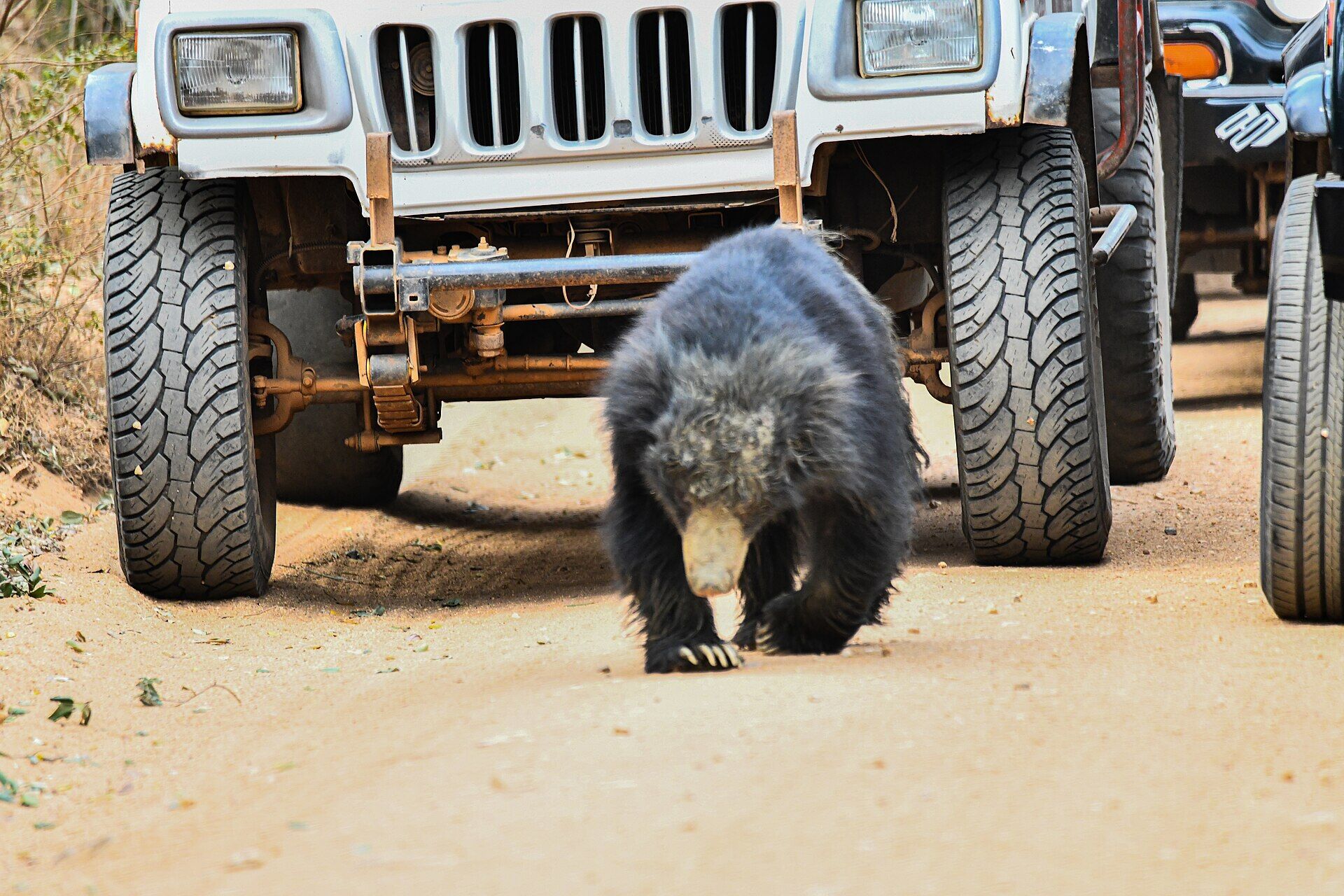
Sloth bears are unmistakable. The coat is long, shaggy and almost unkempt, with the longest hairs forming a thick ruff around the shoulders and neck. Most individuals are jet black with a creamy white V or Y-shaped patch on the chest; some are rust-coloured and lack the patch altogether.
The muzzle is long, pale and highly mobile, with protrusible lips, missing upper incisors and a palate adapted for sucking. The claws are pale, sickle-shaped and around 10 cm long. The ears are very large and floppy, and the tail (15 to 18 cm) is the longest of any bear.
Range and habitat
Sloth bears live across the Indian subcontinent: through most of India, into Sri Lanka and Nepal. The species is extinct in Bangladesh. They favour dry deciduous forest, scrub and grassland mosaics with rocky outcrops, termite mounds and reliable water. They also persist around the edges of farmland and in plantation country, and those mosaics are where most conflict happens.
Diet and foraging
Sloth bears are the most insectivorous of the ursids. Termites and ants make up the bulk of the diet by mass for most of the year, and the technique is one of the most specialised in the bear family. The bear locates a mound by smell, rips it open with those long claws, blows out the loose soil with a sharp blast of air, and then sucks the insects up through the gap left by the missing upper incisors, in audible bursts that can last close to a minute.
The noise carries around 180 metres in still forest, which makes a feeding sloth bear one of the easier large mammals to locate by ear.
Fruit is the second pillar of the diet, especially in the monsoon: mango, jackfruit, fig, ber, mahua, sugar cane and the pods of the golden shower tree. The species is famously fond of honey and will tear open bees’ nests for comb and larvae. Mothers feed cubs a regurgitated, half-digested paste of fruit and honeycomb, known as bear’s bread, which hardens into an edible mass.
Reproduction and lifecycle
Breeding season varies with location. Indian sloth bears typically mate from April to June and give birth in December or January; Sri Lankan bears may mate year-round. Gestation, with delayed implantation, lasts around seven months.
Litters are usually one or two cubs, occasionally three. Cubs are born blind in dens, caves or under boulders, and weigh a few hundred grams. They develop quickly: walking at about a month, riding on the mother’s back as she travels and climbs, and staying with her until they are around 2.5 to 3 years old, longer than most other bears.
Unlike many bears, adult males are reported to be relatively tolerant of cubs, although infanticide still occurs.
Behaviour
Sloth bears are mainly nocturnal where there is heavy human activity and crepuscular elsewhere. They do not hibernate and are active year-round, which is unusual for a large bear, and they announce themselves with loud grunting, huffing and snuffling as they forage.
They are very vocal compared with other bears: barks, screams, grunts, roars, snarls and yelps all feature in encounters with rivals, predators or surprised humans. They climb well, including on smooth bark, and will hang upside down from branches, which is part of why early European naturalists mistook them for a kind of sloth in the first place.
Are sloth bears dangerous to humans?
On a per-encounter basis, sloth bears are among the most dangerous bears in the world. They do not retreat the way American black bears or sun bears usually do. They stand their ground, attack with real ferocity, and go for the face and head, which is why the injuries are so distinctive and so well documented in the old Indian hunting literature.
Most attacks are reactive: a startled bear, a mother with cubs, or a bear cornered in heavy cover. The species is responsible for a substantial number of deaths and many more disfiguring injuries in India each year. For practical advice see our bear safety guide.
Conservation status and threats
The IUCN lists the sloth bear as Vulnerable with a declining population, and estimates put the total at fewer than 20,000 animals, the majority in India. The pressures:
- Habitat loss to agriculture, mining and infrastructure across the dry forests of central India.
- Poaching for gall bladder, fat, claws, and historically cubs for the dancing bear trade. India freed its last documented dancing bear in 2009, but illegal cub capture still surfaces.
- Retaliatory killing after attacks on people.
- Fragmentation that forces bears into repeated close contact with farms and villages.
Wildlife SOS took hundreds of bears off the streets over a fifteen-year campaign and still runs the sanctuaries that house them, alongside anti-poaching work. For the wider picture see our bear conservation guide.
Sloth bear FAQ
Are sloth bears actually sloths?
Why are sloth bears so aggressive toward humans?
What do sloth bears eat?
How many sloth bears are left in the wild?
Are dancing bears still legal in India?
Related reading
- Sun bear
- Asian black bear
- Spectacled bear
- Types of bears: all eight species
- Bears in India
- Bear behaviour
Updated 28 September 2026: corrected the sloth bear’s range and the origin of its name.


The cub-riding thing is the fact I bring up at dinner. Nobody believes a bear carries its cubs around on its back until they look up a photo.
I get the same reaction every time. What gets me is how big some of those cubs look while she’s still carrying them.
Ha, the one my brother found had two cubs on board and the mother looked completely unbothered.
I’d always heard the name came from early naturalists thinking they were sloths. Was it the hanging upside down that did it, or the long claws? I’ve seen both explanations.