

Asian Black Bear Profile: Facts, Diet & Habitat Guide
Last updated: November 16, 2026
5 min read
The Asian black bear (Ursus thibetanus), also called the moon bear for the pale crescent on its chest, is a medium-sized forest bear native to deciduous and mixed forests across south and east Asia. It is one of the most heavily exploited bears in the world for its gall bladder and bile.
Key facts at a glance
| Attribute | Asian black bear |
| Scientific name | Ursus thibetanus |
| Family | Ursidae (genus Ursus) |
| Length (head and body) | 1.2 to 1.9 m (47 to 75 in) |
| Weight | Males 60 to 200 kg (132 to 441 lb); females 40 to 125 kg (88 to 276 lb) |
| IUCN Red List status | Vulnerable, population decreasing (2016, amended 2020) |
| Population | No reliable global figure. National figures: about 28,000 in China, 12,000 to 19,000 in Japan, 5,000 to 7,000 in India (IBA) |
| Lifespan | Into the mid to late twenties in the wild; the oldest recorded captive individual reached 44 |
| Range | Iran, Afghanistan, Pakistan, the Himalayas, Southeast Asia, eastern China, the Korean peninsula, Russian Far East, Japan and Taiwan |
Recognised subspecies include the Himalayan black bear, the Formosan black bear of Taiwan, the Japanese black bear, and the Tibetan, Baluchistan, Ussuri and Indochinese forms.
What makes an Asian black bear an Asian black bear
The signature mark is the pale V or crescent on the chest, almost always present in black-furred individuals, often bordered by a thick mane-like collar of long fur around the neck. The crescent gives the species the name “moon bear” across much of its range.
Bodies are stocky, with a large head, broad muzzle and powerful forelegs. The fur is usually jet black, sometimes brown or blonde, and thicker around the shoulders than elsewhere. Eyesight and hearing are unremarkable. The sense of smell is excellent.
Compared with the American black bear, Asian black bears have a more pronounced chest marking, a heavier neck ruff and a more arboreal lifestyle.
Range and habitat
Asian black bears occur in a long arc from eastern Iran across the Himalayas and Tibet, through southwest China, Indochina, eastern China, the Korean peninsula and the Russian Far East, with island populations in Japan and Taiwan. They prefer deciduous, mixed and coniferous forest, especially mature oak and beech stands that produce reliable mast crops.
Across most of the range they move altitudinally with the season: high in summer for berries and ants, dropping into valley forest in autumn to fatten on acorns, beechnuts and chestnuts before denning.
Diet and foraging
Asian black bears are omnivores with a strong plant bias. The annual diet runs through a predictable cycle: green vegetation and fruit from May to June, cherries, vines and grapes from July to September, then heavy reliance on acorns, beechnuts and other tree mast from autumn into early winter.
They also take insects, especially ants and bee larvae, plus small mammals, carrion, fish, and occasionally livestock and crops. Where the mast crop fails, bears move into farms and villages looking for substitutes, which is the main flashpoint for conflict.
The species hibernates in the colder, more northern parts of its range. Tropical and lower-elevation populations may stay active year-round or den only briefly.
Reproduction and lifecycle
Mating runs from mid June to mid August. Gestation, with delayed implantation, lasts seven to eight months. Cubs are born in caves, hollow trees or den structures in winter or early spring, typically one to four per litter, weighing only around 370 grams (13 oz) at birth.
Cubs stay with their mother for around two years. The species reaches sexual maturity at three to four years.
Behavior and intelligence
Asian black bears are the most arboreal of the large bears. They build daytime resting platforms in trees by bending and breaking branches into nest-like structures, and feed extensively in the canopies of oak, cherry and bee trees.
They are largely solitary, mostly nocturnal in areas under heavy human pressure, and quick on the ground over short distances, comfortably faster than a person. Vocalisations include grunts, huffs and a loud, almost roaring alarm call when surprised.
Are Asian black bears dangerous to humans?
Asian black bears have the unwelcome distinction of being among the most aggressive bears in conflict situations, particularly the Himalayan form. Fatal incidents recur in India, Nepal, Bhutan, parts of Japan and the Russian Far East.
The drivers are familiar: bears habituated to crop fields, hunters wounding bears, surprised mothers with cubs, and people working alone in dense forest with poor visibility. The species also stands its ground more readily than the American black bear, frequently rising on its hind legs when threatened.
For practical responses to bear encounters, see Bear Safety.
Conservation status and threats
The IUCN classifies the Asian black bear as Vulnerable with a declining population. There is no reliable global population estimate. Various figures circulate online, but the assessments themselves say the total is poorly known and that most local populations are fragmented. We would rather tell you that than repeat a number we cannot stand behind.
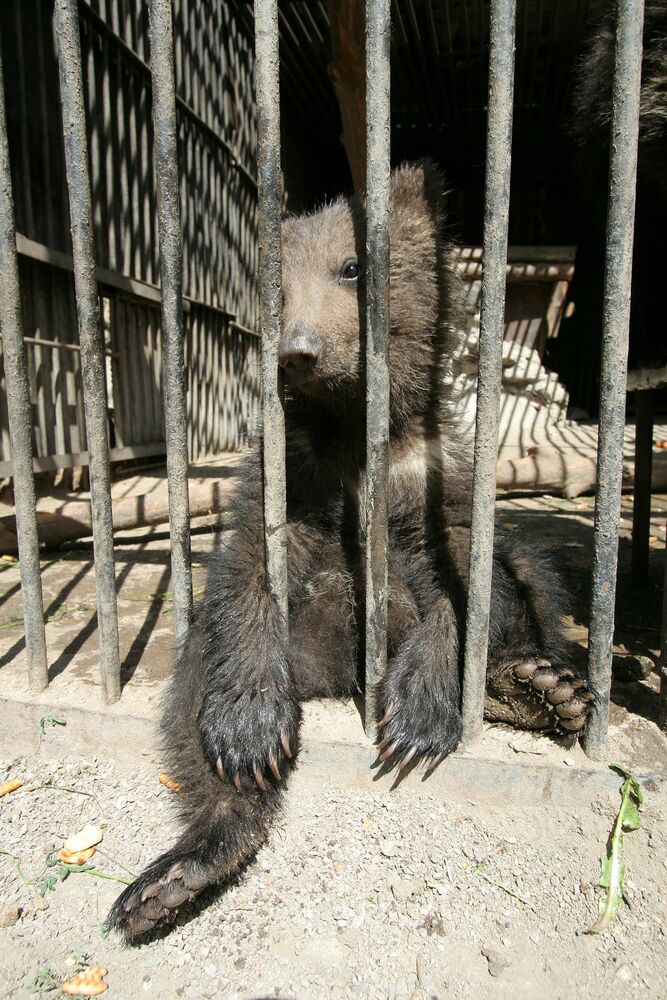
The biggest threats are habitat loss to logging and farmland conversion, illegal hunting for body parts (especially the gall bladder, used in traditional medicine), and the bear bile farming industry, in which bears are kept caged for decades and milked for bile. Animals Asia and Free the Bears continue to rescue bears from these farms and to push for full bans. For the wider picture, see Bear Conservation.
Fun and surprising Asian black bear facts
- The “moon bear” name comes from the crescent-shaped pale patch on the chest, present in nearly every individual.
- They build platform nests in the canopy from broken branches, then sleep on them through the day.
- The Formosan black bear is a national symbol in Taiwan and the face of conservation campaigns there.
- The oldest documented Asian black bear was a captive animal that reached 44 years.
- Tigers are among the few natural predators of Asian black bears. In the Russian Far East, Amur tigers take adults as well as young animals, so growing up is not a complete escape from the threat.
Asian black bear FAQ
Why are Asian black bears called moon bears?
Are Asian black bears endangered?
What is bear bile farming?
Where do Asian black bears live?
What is the difference between an Asian black bear and an American black bear?
Related reading
If you found this profile useful, the following guides go deeper on bears, conservation and safety. If this species captures your imagination, our roundup of bear gifts has thoughtful picks that celebrate them.
- American Black Bear
- Sun Bear
- Sloth Bear
- Brown Bear
- Types of Bears: A Complete Guide to All 8 Species
- Bear Conservation
- Bear Safety
- Bear Behavior
Updated 28 September 2026: corrected the claim that Asian and American black bears are each other’s closest relatives.
Updated 16 November 2026: added the assessment year and national population figures.



I had always read that the Himalayan bears were the more aggressive form, but assumed that was reporting bias since they live closer to more people. Is there any way to tell?
I think reporting bias is part of it, but not the whole story. Himalayan bears share dense forest and crop edges with people who often work alone, and a close surprise is where most of those incidents begin.
We keep a little notebook of bear facts at home and my son underlined the tree platforms twice. Do they ever reuse the same nest?