
Sun Bear Profile: Facts, Diet & Habitat Guide
Last updated: November 16, 2026
5 min read
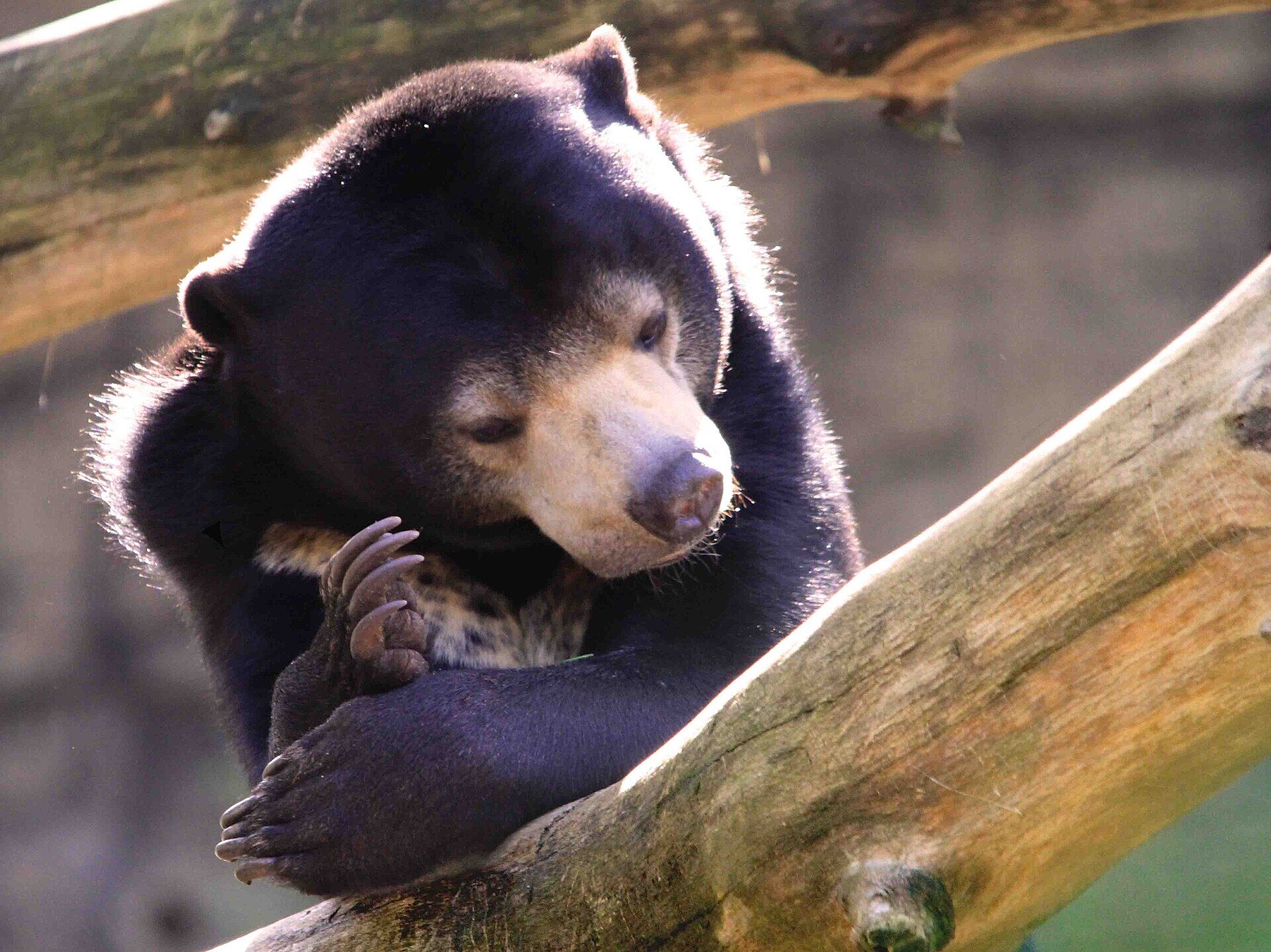
The sun bear (Helarctos malayanus) is the smallest of the world’s eight bear species and the only one that lives almost entirely in tropical lowland rainforest. It is also one of the least studied. Despite that, it has a vivid trademark: the creamy chest patch that gave the species its English name.
Key facts at a glance
| Attribute | Sun bear |
| Scientific name | Helarctos malayanus |
| Family | Ursidae (own genus Helarctos) |
| Length (head and body) | 1.0 to 1.4 m (39 to 55 in) |
| Shoulder height | Around 70 cm (28 in) |
| Weight | 25 to 65 kg (55 to 143 lb); males typically 10 to 20 percent larger than females |
| IUCN Red List status | Vulnerable, population decreasing (2017) |
| Population | No reliable estimate; declined by more than 30 percent over 30 years |
| Range | Mainland Southeast Asia, Sumatra, Borneo and adjacent islands |
Two subspecies are recognised: H. m. malayanus on the mainland and Sumatra, and H. m. euryspilus, the smaller Bornean sun bear.
What makes a sun bear a sun bear
Sun bears look almost unfinished next to their northern relatives. They are short-legged, small-eared, and wear a short, sleek, jet-black coat that shrugs off constant rainforest moisture. The chest patch is usually pale orange or cream and ranges from a clean U-shape to a ragged sunburst. No two are quite the same, which is why researchers use them to tell individuals apart.
The muzzle is short and the tongue is startlingly long, commonly cited at around 20 to 25 cm. The claws are long, heavy and sickle-shaped, built for tearing apart rotten wood and for getting up smooth tropical hardwoods. For an animal this size the jaws are disproportionately powerful.
Range and habitat
Sun bears occur from northeastern India, Bangladesh and southern China through Myanmar, Thailand, Laos, Cambodia, Vietnam, Peninsular Malaysia and into Sumatra and Borneo. They are now functionally extinct across much of southern China.
Their preferred habitat is dense tropical evergreen rainforest with old-growth structure, hollow trees and rich insect populations. They will use lower montane forest and disturbed forest mosaics, but rarely venture into open or heavily settled country.
Diet and foraging
Sun bears are omnivores with a strong insect-and-fruit emphasis:
- Termites, ants, beetle larvae and bee brood, extracted from rotten wood and underground nests with the long tongue and heavy claws.
- Wild figs, durian, jackfruit, mangosteen and a wide range of seasonal rainforest fruits.
- Honey and honeycomb, which give the species its other common name, honey bear.
- Small vertebrates: lizards, birds, rodents, the occasional young deer.
- Cultivated crops including oil palm fruit, rubber, coconut and cocoa, which is what puts them in direct conflict with plantation owners.
Sun bears do not hibernate. The rainforest supplies food year-round, so there is no seasonal famine to den through.
Reproduction and lifecycle
Reproduction is poorly documented in the wild, partly because the species is so cryptic. Sun bears appear to lack a defined mating season, and oestrus can occur at any time of year. Gestation, with possible delayed implantation, lasts three to seven months.
Litters are small, usually one cub and occasionally two. Newborns weigh around 280 to 325 grams, blind, hairless and entirely dependent. Cubs stay with their mother for around two years and reach sexual maturity at three.
Behavior
Contrary to how they are often described, sun bears are mainly active during the day. Where there is heavy human pressure they shift toward night activity, which is probably where the “nocturnal bear” reputation came from. In undisturbed forest they are daytime animals.
They are mostly solitary, although mothers and well-grown cubs sometimes travel together. They are exceptional climbers and spend significant time in the canopy, often building feeding and resting platforms in forked branches.
Vocalisations are surprisingly varied for a small bear, including barks, huffs, growls and a loud alarm call when threatened.
Are sun bears dangerous to humans?
Despite their size, sun bears have a reputation for being among the most defensive bears in a close encounter. Surprised at short range they may go straight to an attack, and the combination of long claws and a strong bite does serious damage. Most encounters, though, are with a fast-fleeing bear that simply disappears into the forest before you have registered what it was.
Conflicts usually involve plantation owners protecting crops, hunters wounding bears, or a female defending cubs at close range. Practical bear-country protocols are covered at Bear Safety.
Conservation status and threats
The IUCN lists the sun bear as Vulnerable with a declining population, estimating a fall of at least 30 percent over three sun bear generations, roughly the last 30 years. The drivers:
- Large-scale deforestation across Southeast Asia, especially for oil palm and pulpwood.
- Illegal hunting for gall bladders and paws, and live cubs for the pet trade.
- Habitat fragmentation isolating what remains.
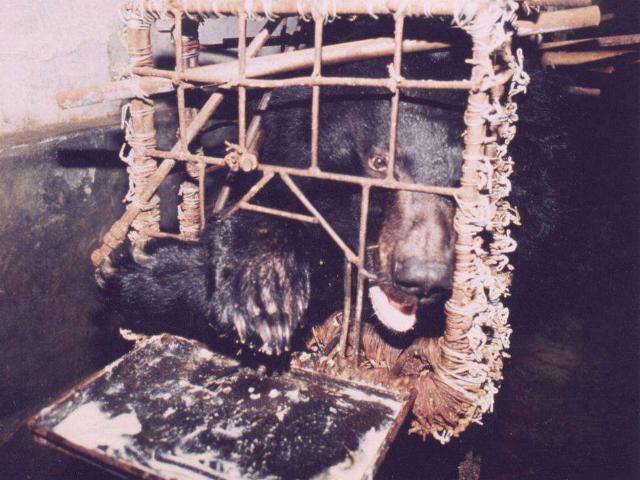
- Bear bile farming, less industrial than for the Asian black bear but documented in Vietnam and Laos.
Sanctuary work by the Bornean Sun Bear Conservation Centre in Sabah and by Free the Bears across mainland Southeast Asia continues to rescue former pets and farm bears. For the wider picture, see Bear Conservation.
Fun and surprising sun bear facts
- They are the smallest bears in the world, with adults down to around 25 kg.
- The genus name Helarctos is built from the Greek words for sun and bear, after the chest patch.
- Sun bears have famously loose skin, which lets a bear twist round inside it to bite something that has grabbed it from behind.
- They are the only bear that lives entirely in tropical forest and never enters true hibernation.
- The Bornean sun bear, H. m. euryspilus, is smaller again than the mainland form.
- Every chest patch is different, so researchers can identify individual bears from a photo.
Sun bear FAQ
Why are they called sun bears?
How big do sun bears get?
Where do sun bears live?
Are sun bears nocturnal?
Are sun bears endangered?
What do sun bears eat?
Related reading
If you want to go further on bears, conservation and safety, start with the guides below. And if the sun bear has got its hooks into you, the bear gifts roundup has a few things worth a look.
- Sloth Bear
- Asian Black Bear
- Spectacled Bear
- Brown Bear
- Types of Bears: A Complete Guide to All 8 Species
- Bear Conservation
- Bear Safety
- Bear Behavior
Updated 16 November 2026: added the assessment year and population line.


My daughter picked the sun bear for a school project on rainforests, mostly because it’s the smallest. The loose skin trick is what she ended up presenting. Do the other tropical bears skip hibernation too?
had no idea the Bornean ones were their own smaller subspecies. is there a weight range for them anywhere? the table only covers the species as a whole