
Kodiak Bear Profile: Facts, Diet & Habitat Guide
Last updated: November 16, 2026
5 min read
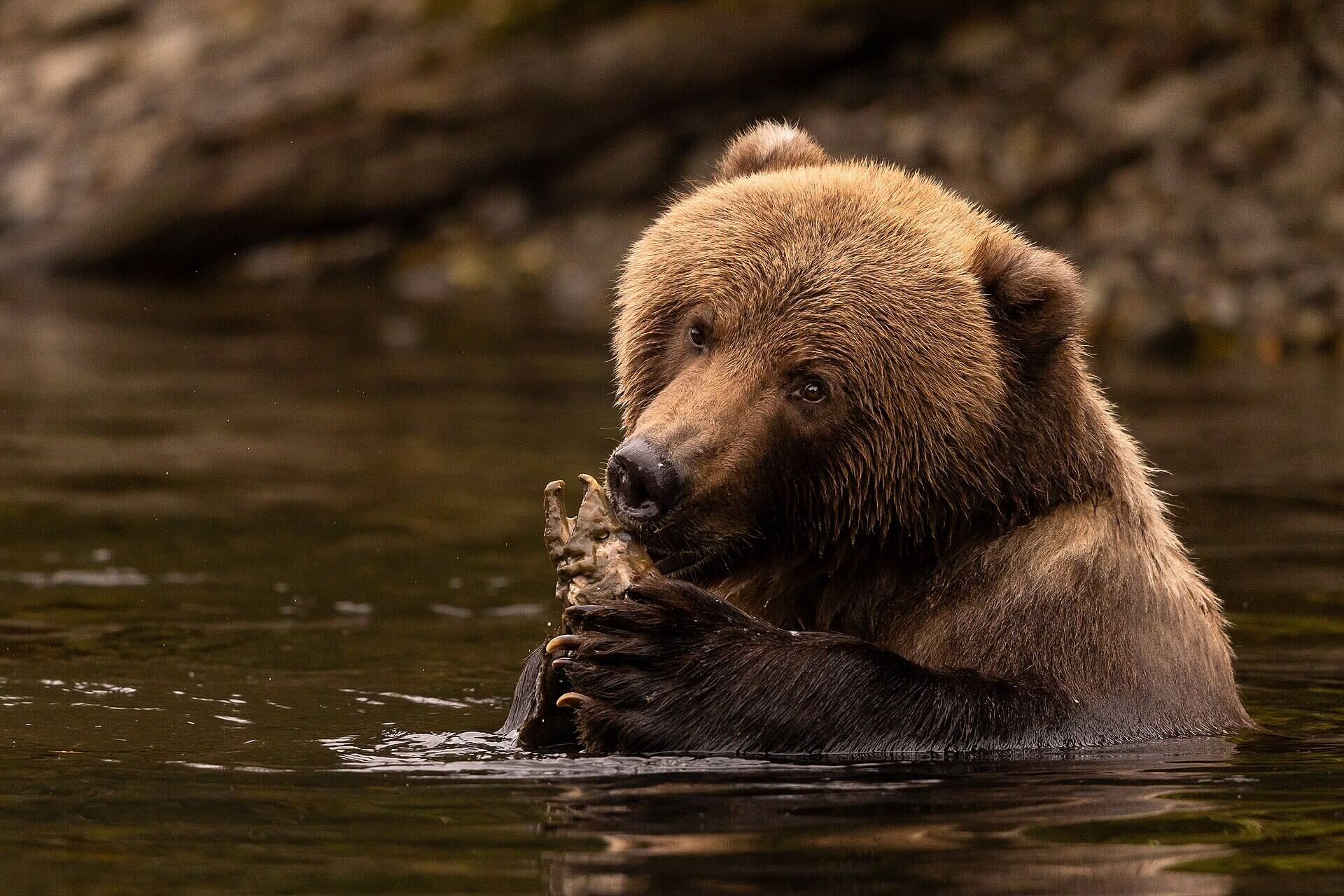
The Kodiak bear (Ursus arctos middendorffi) is the giant coastal subspecies of the brown bear, native exclusively to the Kodiak Archipelago of southwestern Alaska. It shares the title of largest land carnivore on Earth with the polar bear, and large males can pass half a tonne.
Key facts at a glance
| Attribute | Kodiak bear |
| Scientific name | Ursus arctos middendorffi |
| Parent species | Ursus arctos (brown bear) |
| Length (head and body) | Up to 2.44 m (96 in); shoulder height up to 1.33 m |
| Weight | Adult males 272 to 635 kg (600 to 1,400 lb); adult females 136 to 318 kg (300 to 700 lb) (USFWS) |
| IUCN Red List status | Listed under brown bear (Least Concern globally) |
| Lifespan | The oldest known wild male was 27, the oldest known wild female 35 (ADF&G) |
| Range | Kodiak, Afognak and adjacent islands in the Kodiak Archipelago, southwestern Alaska: roughly 13,000 km² (ADF&G) |
Population: about 3,500 Kodiak bears in 2026, all on the archipelago (ADF&G; USFWS), with no exchange with mainland Alaskan brown bears for around 12,000 years (ADF&G).
What makes a Kodiak bear a Kodiak bear
Apart from raw size, Kodiak bears are visually similar to other coastal brown bears. The hump on the shoulders is pronounced, the head is massive and broad, and the coat is usually dark brown, sometimes blonde, with denser underfur than inland populations. The skeleton is heavy-boned and the muscle mass disproportionate even for a brown bear, products of 12,000 years of evolution on an island with abundant salmon and few competitors.
Standing on hind legs, a large male Kodiak can reach 3 m (10 ft) tall. Their claws are shorter and more strongly curved than inland brown bears, an adaptation to gripping wet rock and salmon rather than digging.
Range and habitat
Kodiak bears are found only on the islands of the Kodiak Archipelago in southwestern Alaska, principally Kodiak, Afognak, Shuyak, Raspberry and Uganik islands. The archipelago covers roughly 13,000 km² and includes a mix of mountain ranges, river valleys, salmon-rich streams, coastal sedge meadows, dense alder thickets and open tundra.
The bears use the full elevational range from sea level to mountain ridges, often following salmon runs from the coast inland through summer and autumn.
Diet and foraging
Kodiak bears are omnivores, but the subspecies’ famous size is fuelled by salmon. Five species of Pacific salmon spawn in Kodiak streams from late spring through autumn: pink, chum, sockeye, coho and chinook. A single adult bear can take in tens of thousands of calories a day during the height of the run, often eating only the energy-rich brains, roe and skin and leaving the rest for scavengers.
Outside the salmon season, the diet includes:
- Beach grasses and sedges in spring.
- Salmonberry, blueberry, crowberry and elderberry through summer and autumn.
- Roots, bulbs and corms dug from coastal meadows.
- Deer and elk (introduced to the archipelago), small mammals, and carcasses washed up on the shore.
- Marine invertebrates and the occasional dead whale.
Reproduction and lifecycle
Kodiak bears reach sexual maturity at around five years old. The mating season runs from May to June, with delayed implantation and cubs born in the den in January or February. Litters are typically two cubs, occasionally three.
Cubs emerge from the den in May or June and stay with their mother for up to three years. Cub mortality is significant: adult males regularly kill unrelated cubs, both to remove competitors and to bring females back into oestrus. Mothers respond with extreme aggression, but a determined large male will often win the encounter.
Behavior and intelligence
Kodiak bears are technically solitary, but the salmon runs force them to live in close, complex social proximity for months at a time. Studies on Kodiak document a flexible dominance hierarchy in which the largest males get the best fishing sites, females with cubs avoid those males, and subadult bears occupy the margins.
For their size, Kodiak bears are surprisingly mobile. They can swim a mile or more uninterrupted, often with just the head and nose above the surface. The Alaska Department of Fish and Game puts the top speed of a brown bear at up to 64 km/h (40 mph) in a short burst, which is not a distance a person can win.
Are Kodiak bears dangerous to humans?
Yes, like any large brown bear. That said, fatal attacks are rare given the bears’ size and abundance. Kodiak bears generally avoid humans unless habituated to garbage or food, surprised at very close range, or defending a kill or cubs.
Hunting and bear-viewing are both major industries on the archipelago, and the subspecies is closely monitored. Practical bear-country protocols are at Bear Safety.
Conservation status and threats
The IUCN lists the Kodiak bear under the brown bear species, classified globally as Least Concern. Locally the population is stable at about 3,500 bears in 2026 (ADF&G), managed by the Alaska Department of Fish and Game under a strict permit-and-quota hunting system that has been a textbook example of regulated trophy management since the creation of the Kodiak National Wildlife Refuge in 1941 (ADF&G).
The main risks for the population are habitat-level rather than population-level: climate change effects on salmon runs, oil spill risk in surrounding waters, and the long-term consequences of being one isolated island population with no genetic exchange. For wider context, see Bear Conservation.
Fun and surprising Kodiak bear facts
- Kodiak bears have been genetically isolated from mainland brown bears for around 12,000 years, since the end of the last ice age.
- A large male Kodiak can reach 3 m (10 ft) when standing on its hind legs and weigh more than three average adult humans put together.
- The Journal of Mammalogy listed one male at 748 kg (1,648 lb). The heaviest captive Kodiak was Clyde at the Dakota Zoo, who weighed 966 kg (2,130 lb) when he died in 1987 (North American Bear Center).
- The Kodiak Archipelago covers around 13,000 km² and is home to about 3,500 bears in 2026 (ADF&G), one of the densest brown bear populations on Earth.
- Local Alutiiq people call the bear Taquka’aq, and traditional stories treat the animal as a near-human ancestor.
- Despite the bulk, Kodiaks can swim over a kilometre between islands without rest, often crossing channels in search of salmon streams.
Kodiak bear FAQ
Is a Kodiak bear the same as a grizzly bear?
How big is the largest Kodiak bear?
Where do Kodiak bears live?
How many Kodiak bears are there?
Are Kodiak bears protected?
Related reading
- Brown Bear
- Grizzly Bear
- Polar Bear
- Types of Bears: A Complete Guide to All 8 Species
- Bear Conservation
- Bear Safety
- Fat Bear Week
Updated 16 November 2026: corrected the weight and record figures and linked the sources for population, weight and range.




Eating only the brains, roe and skin sounds wasteful until you see the gulls cleaning up behind them. Watched that on a salmon river in Alaska years ago, though not on Kodiak.
How much do the introduced deer and elk actually matter to them? I wonder if the bears took to hunting them or mostly eat what the hunters leave behind.