

10 Best Places to See Bears in the Wild Worldwide
Last updated: November 16, 2026
5 min read
Bear-watching has matured as a travel category. There are now established, ethically run viewing operations in North America, South America, Europe and Asia. This guide is the high-level overview: ten destinations, what species you will see, when to go, and how to book. For background on why bear-watching works as a conservation tool rather than pure tourism, see our bear conservation pillar.
Eight bear species roam the planet today, and a handful of locations consistently outperform everywhere else for viewing them in the wild. The shortlist below is built on density of sightings, accessibility, viewing infrastructure and seasonality. Most of these spots have decades of established viewing platforms and predictable bear behaviour, which means a high chance of seeing bears safely and at close range. Before you book, read our bear safety guide and the types of bears overview so you know what to expect.
10 of the best places to see bears in the wild worldwide
1. Churchill, Manitoba, Canada (polar bears)
Churchill on the western shore of Hudson Bay is the polar bear capital of the world. From mid-October to mid-November the Western Hudson Bay bears gather on the tundra outside town, waiting for sea ice to form so they can hunt seals again. Operators like Frontiers North and Natural Habitat run tundra buggies that put you within metres of resting and play-fighting adults. Read more in our Churchill guide and our polar bear species profile.
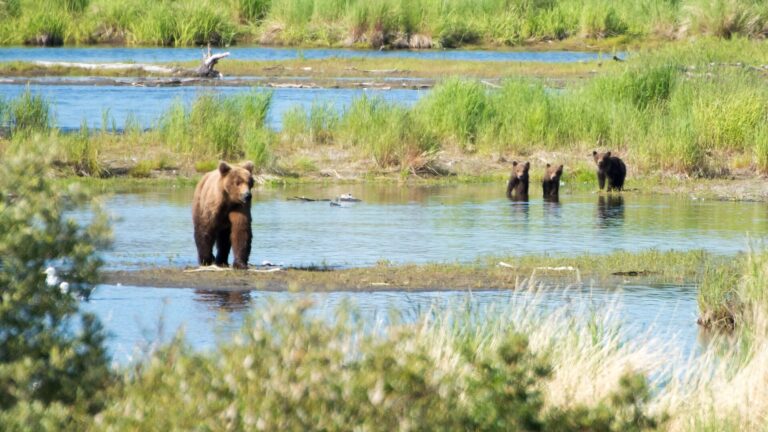
2. Brooks Falls, Katmai National Park, Alaska (brown bears)
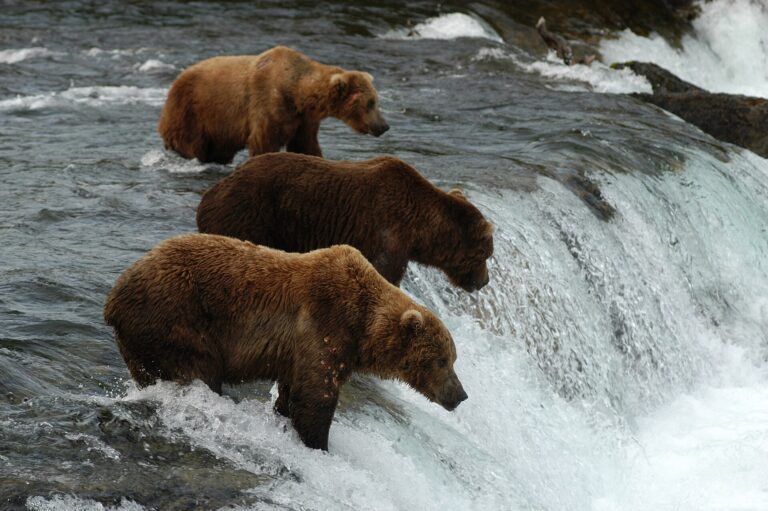
In July and again in September, dozens of brown bears stack up at Brooks Falls to catch sockeye salmon mid-leap. These are the same bears voted on every autumn during Fat Bear Week. The wooden viewing platforms at Brooks Camp give you postcard angles within 30 metres of fishing adults. Lodge rooms go by lottery each December for the next season, and day trips fly in from King Salmon, Anchorage or Homer.
3. Lake Clark National Park, Alaska (coastal brown bears)
Less crowded than Katmai. Silver Salmon Creek and Chinitna Bay are open sedge meadows where mothers graze with cubs in June, then switch to clamming on the tidal flats. Viewing here is on foot with a guide. Most lodges cap groups at six guests, which often means hour-long sit-downs ten metres from a feeding sow.
4. Yellowstone National Park, USA (grizzlies and black bears)
The Hayden and Lamar Valleys are reliable for grizzly sightings between May and September, especially at dawn and dusk. Use a spotting scope at the pullouts along the Grand Loop Road. The Greater Yellowstone Ecosystem grizzly population was estimated at about 1,050 in 2024 (USFWS). Black bears are more common in roadside meadows in the north of the park.
5. Great Bear Rainforest, British Columbia, Canada (spirit bears)
The only place on Earth to see the Kermode bear, the white-coated form of the American black bear. Read our 10 facts about the spirit bear for background. Most viewing is from First Nations-run camps on Princess Royal Island and Gribbell Island in September and October during the salmon run.
6. Wapusk National Park, Manitoba, Canada (polar bear mothers and cubs)
In February and March, polar bear mothers emerge from maternity dens in Wapusk with new cubs. Specialised lodges operate winter expeditions where you can watch tiny cubs take their first steps onto the snow before their mother leads them north to Hudson Bay.
7. Eastern Finland, taiga forest (European brown bears)
Wildlife hides in the boreal forest near Kuhmo and Lieksa, close to the Russian border, put you a few metres from European brown bears, with overnight viewing from purpose-built photography huts. Wolverines and wolves turn up at the same sites.
8. Andean cloud forest, Ecuador and Peru (spectacled bears)
The only bear species in South America. Maquipucuna Reserve near Quito offers guided walks when spectacled bears come to feed on wild avocados. Chaparri Reserve in northern Peru is dry forest and runs a spectacled bear rescue programme. October to December is the best window at Maquipucuna. See our spectacled bear profile for what to look for.
9. Nagarhole and Bandipur, India (sloth bears)
Jungle safaris in Karnataka regularly turn up wild sloth bears feeding at termite mounds. Daroji Sloth Bear Sanctuary in the same state is dedicated to the species. March and April, before the monsoon, give the clearest sightings.
10. Borneo and Sumatra rainforest (sun bears)
The smallest bear species is also the hardest to see in the wild. The Bornean Sun Bear Conservation Centre in Sabah, Malaysia, rehabilitates rescued bears and is the most reliable place to observe them at close range before considering more remote rainforest treks.
When to go: bear viewing season at a glance
- Polar bears, Churchill: mid-October to mid-November.
- Brown bears, Katmai: July for the peak salmon run, September for the fat bears.
- Grizzlies, Yellowstone: May to September, best at dawn.
- Spirit bears, British Columbia: September to mid-October.
- Spectacled bears, Ecuador: October to December.
- Sloth bears, India: March and April.
- European brown bears, Finland: May to August.
- Sun bears, Sabah: year-round, drier April to October.
How to watch bears responsibly
Wild bears are not a backdrop. They are large, intelligent predators reacting to your presence. Three rules apply everywhere:
- Keep distance. Rules vary by park. Yellowstone uses 100 yards (91 m) for bears and 25 yards (23 m) for other wildlife; Katmai uses 50 yards (46 m). Use a long lens, not your feet.
- Carry bear spray in grizzly and black bear country and know how to use it. Read our bear safety guide before you travel.
- Choose accredited operators. A good guide will brief you on body language, control group spacing, and never bait wildlife.
What makes a bear-watching destination ethical
Good operators share four features. The bears are wild and free-ranging, never fed. Group sizes are small, typically 6 to 12 people. Guides are local and trained, so the money stays in the bear range community. And the operator works with the relevant land manager (national park service, state forestry, or the indigenous community that holds the territory) rather than around them.
Avoid anything advertised as a guaranteed sighting or a cub-petting experience. Both are red flags that the bears are being baited, habituated or held captive.
Safety on a bear-watching trip
Even on a well-run trip you are at close range to a wild predator. Most ethical operators run a 20-minute safety briefing on day one. Bring binoculars (8x or 10x), a long lens (300mm minimum) and proper weather gear. Bear-watching seasons in the major destinations are typically wet, cold, or both.
Frequently asked questions
Where is the best place in the world to see polar bears?
Churchill, Manitoba, from mid-October to mid-November, when the largest predictable gathering of wild polar bears in the world waits for Hudson Bay to freeze.
Where can you see grizzly bears in the wild in the US?
Yellowstone National Park (Hayden and Lamar Valleys), Glacier National Park in Montana, and Katmai National Park in Alaska are the three most reliable areas.
Where is the most reliable place to see wild bears at all?
Katmai National Park in Alaska during the July salmon run. Brown bear density at Brooks Falls is the highest of any accessible viewing site, with dozens of bears in a small area for several weeks each summer.
Is it safe to see bears in the wild?
Bear viewing with experienced guides at established locations like Brooks Falls or Lake Clark is statistically very safe. Fatal attacks are extremely rare relative to the millions of viewer-days logged each year. The risk rises sharply when people approach bears on their own without guides or bear spray.
What is the best time of year to see brown bears?
July at Brooks Falls for fishing, September for the heaviest bears just before hibernation, and June at Lake Clark for sow-and-cub viewing on the sedge flats.
Related reading
- Churchill, Manitoba: the polar bear capital
- Hokkaido bear watching guide
- Types of bears: a complete guide to all 8 species
- Bear safety in the wild
- Bear conservation pillar
Updated 28 September 2026: corrected where bear-watching operations exist, the Brooks Lodge lottery, park distance rules and the 2025 Yellowstone grizzly estimate.
Updated 16 November 2026: updated the Greater Yellowstone grizzly estimate to the 2024 figure.

Is the Brooks Lodge lottery worth entering, or do most people just do the day trip from King Salmon? Trying to plan for a July visit and the lodge sounds like a long shot.
Pack proper waterproofs. On our Katmai day trip the cheap jacket I bought was soaked through within an hour and I spent the afternoon shivering on the platform. Still worth it.
We stay near the north entrance to Yellowstone most summers and the Lamar pullouts at dawn are the real deal. Half the time the scope crowd spots the grizzly before you do. Evenings were hit and miss for us.