
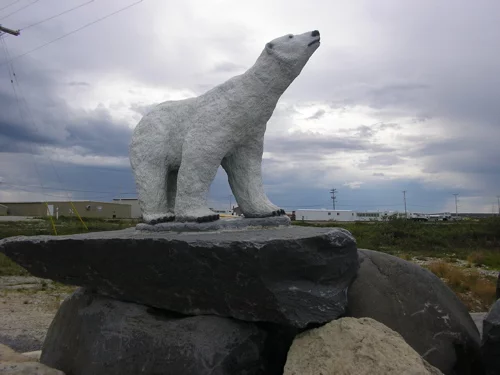
Churchill, Manitoba: The Polar Bear Capital of the World
Last updated: November 16, 2026
7 min read
Churchill, Manitoba sits on the western shore of Hudson Bay, and every autumn polar bears gather on the tundra outside town waiting for the sea ice to reform. For travellers it is the most reliable place on Earth to see wild polar bears at close range. This guide covers the operators, the conservation organisations working on the ground, and what a warming Hudson Bay is doing to the timing of the bear season. For the wider context, see our guide to Polar Bears International.
Churchill has a permanent population of around 870 people and no road in. For most of the year it is a quiet port town. Then, from October, the bears arrive. That gathering, the largest predictable congregation of wild polar bears in the world, is what gives the town its title.
Where is Churchill?
Churchill sits at 58 degrees north on the Hudson Bay coast in northern Manitoba, Canada. This coastline is near the southern edge of polar bear range and the first part of the bay to freeze each autumn. The town is not connected to the Canadian road network. Visitors arrive by train from Winnipeg (roughly 45 hours) or by air on Calm Air from Winnipeg or Thompson.
Why so many polar bears gather there
Polar bears spend the summer fasting on land, having burned through the fat reserves they built hunting seals on the sea ice. As temperatures drop in September and October they migrate to the coast and wait for the bay to freeze. The first ice forms reliably off Cape Churchill, the headland just east of town, so the bears congregate there because it is the fastest route back onto the ice and back to seals.
That pattern has been stable for a very long time, which is what makes Churchill predictable in a way no other polar bear location is.
The polar bear season
Mid-October to mid-November: peak viewing
This is the four-week window when most visitors arrive. Tundra buggies, purpose-built off-road vehicles with viewing platforms, take groups onto the Wildlife Management Area east of town. Sightings of 5 to 15 bears per day are normal. Mothers with cubs, sub-adults sparring, and large adult males waiting on the shoreline are all routine.
Summer (July to September): belugas and walking bears
Churchill also sits beside one of the world’s great beluga gatherings. Tens of thousands of belugas summer in western Hudson Bay, and several thousand of them move into the Churchill River estuary itself, which is what the summer boat tours are built around. Polar bears are seen on land during this period too, though far less reliably than in autumn.
Winter (February and March): mothers and cubs in Wapusk
Specialist operators run trips into Wapusk National Park south of Churchill to see polar bear mothers emerging from maternity dens with cubs. Conditions are extreme (minus 30 to minus 40 Celsius is normal) and access is by train and then overland to Wat’chee Lodge, which holds a Parks Canada permit for den viewing.
How polar bears and Churchill residents coexist
A town this small surrounded by hungry 400 kg predators needs serious systems. Churchill has them.
- The Polar Bear Alert Program, run by the Manitoba government, operates a 24-hour hotline. Residents call it whenever a bear comes into town, and officers respond within minutes.
- The polar bear holding facility, known locally as the polar bear jail, is a converted aircraft hangar where problem bears are held without food (so they do not associate humans with a meal) until they can be helicoptered north and released.
- Doors stay unlocked. A long-standing local custom: anyone caught outside near a bear can dive into the nearest building, so house doors are deliberately left unlocked during peak bear season.
- Cracker shells, paintball guns and air horns are the standard non-lethal deterrents. Bears that show no fear of people, or that have learned to associate people with food, are the ones that end up in the holding facility.
Climate change and the Churchill polar bears
The Western Hudson Bay polar bear population is the most thoroughly studied in the world. Long-term data shows ice break-up now happening around three weeks earlier than it did in the 1980s, which extends the on-land fasting period.
The subpopulation has fallen sharply over that period, from well over a thousand bears in the 1980s to about 618 in the 2021 aerial survey. Females arrive on land lighter and raise fewer cubs successfully. The autumn gathering is still spectacular, because the bears that remain still funnel through the same narrow stretch of coast, but the long-term trend is downward and it tracks sea ice directly.
What a trip to Churchill looks like
A typical autumn trip runs 5 to 7 days. Most visitors fly Winnipeg to Churchill, stay in town for 4 nights, and run 2 or 3 days of tundra buggy viewing in the Wildlife Management Area. Itineraries usually include:
- A morning at the Itsanitaq Museum, which holds one of the world’s best collections of Inuit art and artefacts.
- An evening aurora-watching session (Churchill sits directly under the auroral oval).
- A visit to Cape Merry, where you can sometimes see bears from the shore at low tide.
- Dog-sled or helicopter add-ons depending on the operator.
Frontiers North Adventures and Natural Habitat Adventures run tundra vehicles in the Wildlife Management Area, and Churchill Wild runs fly-in lodges along the coast. Independent visiting is possible in town, but you need a tour to get out onto the tundra where the bears gather.
How to book
There are essentially three routes. The dedicated operators run multi-day all-inclusive packages from Winnipeg covering the flight, accommodation and buggy days. These are not cheap: expect several thousand Canadian dollars per person and considerably more at the premium end. Bookings open 12 to 18 months ahead and sell out.
Independent travel is possible. Flights from Winnipeg run year-round, the town has hotels and bed and breakfasts, and buggy day-trips can be booked separately. It costs less but the logistics are harder, and the good operators sell their seasonal allocations early.
When to go, and what is changing
The autumn season splits into three windows:
| Window | Dates | What you see | Conditions |
|---|---|---|---|
| Early season | Mid October to 31 October | Bears moving onto the coast, less concentrated | Highs near 0 C, 9 to 10 hours of daylight |
| Peak | 1 to 15 November | Maximum concentration at Cape Churchill, multiple bears a day | Highs minus 5 to minus 15 C, 8 to 9 hours of daylight |
| Late | 16 November to freeze-up | Bears moving onto forming ice, daily counts dropping | Variable, best aurora chance |
| Outside | December to early October | Bears on the ice or dispersed inland | Not viable for travellers |
The classic Churchill season runs late October to mid-November. In the last decade the ice has been forming later and the bears have spent longer on land and around town, so peak viewing has shifted slightly later, with the best two weeks moving from late October into the first half of November.
Some operators now offer summer beluga and polar bear combination trips in July and August, where bears are seen swimming and resting on coastal islands. That is a different experience from the autumn buggy season and yields very different photography.
Two details that catch first-time visitors. The town hotels are largely block-booked by operators in season, so independent travellers should reserve close to a year ahead for an October or November stay. Frontiers North also runs the Tundra Buggy Lodge, accommodation units parked out on the tundra in the Churchill Wildlife Management Area, and Churchill Wild’s fly-in lodges (Seal River Heritage Lodge, Nanuk Polar Bear Lodge and Dymond Lake Ecolodge) offer ground-level walking with armed guides instead of vehicle viewing.
Packing
This is the coldest wildlife trip most travellers ever do. Some operators supply parkas and boots, so confirm before assuming. The shortlist: a parka and insulated waterproof boots rated well below minus 30 C, glove liners under heavy mittens, chemical hand warmers, a balaclava or neck gaiter, fleece and merino base layers, and eye protection for snow glare. For cameras, a 200 to 600 mm zoom, spare batteries kept in an inner pocket, lens cloths for fogging, and a sealable bag so you can warm the body slowly indoors without condensation inside it. Our bear photography guide has the full kit.
Conservation organisations working in Churchill
The most active groups on the ground are Polar Bears International (research, education and the polar bear live cams), WWF’s Arctic Programme (community patrol funding and collar science), and the provincial Polar Bear Alert Program, the team that keeps people and bears apart in town.
Frequently asked questions
Why is Churchill called the Polar Bear Capital of the World?
Because every autumn the Western Hudson Bay bears funnel onto the tundra east of town while they wait for the bay to freeze. It is the largest predictable congregation of wild polar bears on the planet and the easiest one to reach.
How many polar bears are there near Churchill?
The bears seen around Churchill belong to the Western Hudson Bay subpopulation, which the 2021 aerial survey put at about 618 bears. It has been declining for decades, primarily because of shorter sea-ice seasons.
When is the best time to see polar bears in Churchill?
Mid-October to mid-November, with the peak trending slightly later in recent years as freeze-up is delayed. July and August offer a different summer experience with bears on coastal islands and belugas in the estuary.
How do you get to Churchill?
By air from Winnipeg or Thompson on Calm Air, or by Via Rail train from Winnipeg, a journey of about 45 hours. There is no road into Churchill.
Is it safe to walk around Churchill during polar bear season?
Walking around town during the day is safe, because the Polar Bear Alert Program is highly responsive and residents leave doors unlocked. Walking on the tundra or along the beach alone is not. Tundra buggy tours are the only sensible way to spend prolonged time near the bears. See our bear safety guide for general advice.
Other bear viewing worth knowing
Churchill leads our list of the best places to see bears in the wild worldwide, but there are eight bear species out there. Read our types of bears guide for the full picture, and our polar bear species profile for the animal itself.
Updated 28 September 2026: corrected the train journey time, the Wapusk access route, the tour operators and the 2021 survey figure.
Updated 1 November 2026: added the season windows, lodging and packing advice from our former Churchill tour guide, which now redirects here.
Updated 16 November 2026: added the Western Hudson Bay survey figure.


Has anyone taken the train up from Winnipeg instead of flying? Two days on a train sounds either wonderful or awful and I can’t decide which.
went up for the belugas one july and saw a single bear asleep on the rocks near cape merry, plus more belugas than i could count. not the autumn buggy trip but i’d go back in summer anyway
Our buggy day had a mother and two cubs about forty yards off for nearly an hour. What surprised me was how much sitting there is. You wait, your eyes adjust, and then you notice everything. Want to take my dad next time.