

Cantabrian Brown Bear Profile: Facts, Diet & Habitat Guide
Last updated: November 5, 2026
5 min read
The Cantabrian brown bear is the isolated population of Eurasian brown bears (Ursus arctos arctos) that survives in the Cantabrian Mountains of northern Spain. Reduced to a remnant by the 1990s, it has clawed its way back past 370 animals thanks to decades of strict protection and the work of conservation groups like the Fundacion Oso Pardo (FOP).
Key facts at a glance
| Attribute | Cantabrian brown bear |
|---|---|
| Scientific name | Ursus arctos arctos (Cantabrian population) |
| Parent species | Ursus arctos (brown bear) |
| Length (head and body) | 1.6 to 2.0 m (5.2 to 6.6 ft); shoulder height 0.9 to 1.0 m |
| Weight | Males 115 to 200 kg (254 to 441 lb); females 85 to 150 kg (187 to 331 lb) |
| Protection status | Brown bear globally Least Concern; the Cantabrian population is catalogued in Spain as in danger of extinction, and the small eastern subpopulation is treated as critically endangered |
| Lifespan | 25 to 30 years in the wild |
| Range | Cantabrian Mountains of northern Spain (Asturias, Leon, Galicia, Cantabria, Palencia) |
Genetic analysis treats Cantabrian bears as part of the wider Eurasian brown bear, sharing a lineage with the bears of southern Scandinavia rather than forming a species of their own. Their long isolation has nevertheless produced a distinct conservation unit.
What makes a Cantabrian brown bear distinct
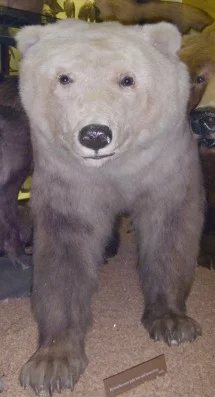
Cantabrian bears are at the smaller end of the brown bear scale, with adult males averaging well under 200 kg and females around 100 kg. Coat colour varies from dark brown to a striking blonde phase that is common in the western subpopulation, with the head and shoulders often paler than the flanks.
Apart from size and colour, they share the brown bear’s standard kit: a muscular shoulder hump, dished face, long claws and rounded ears. Behaviourally they are shy and intensely cautious of humans, a trait selected for by centuries of persecution.
Range and habitat
Cantabrian bears live in two largely isolated subpopulations: a larger western group (Asturias, Leon and Galicia) and a much smaller eastern group (Palencia, Leon and Cantabria), separated by roughly 40 km of less suitable habitat.
Their preferred habitats are mature beech, oak and chestnut forest on the steep slopes of the Cordillera Cantabrica, between roughly 500 and 1,800 m elevation. Bears use rocky outcrops and dense thickets for daytime cover and rear cubs in caves or under boulders.
Diet and foraging
Modern Cantabrian bears are overwhelmingly vegetarian. Roughly 90 percent of what they eat is plant matter: berries (especially blackberry and bilberry), beechnuts, acorns, chestnuts, herbaceous shoots and grasses, along with significant insect intake from ant nests and bee colonies.
The remaining tenth is animal protein: insects, carrion, occasional small mammals and the very rare attempt on livestock. One quiet complication is that EU rules on the rapid removal of livestock carcasses from the countryside, introduced to control BSE, have cut the carrion these bears used to rely on for pre-hibernation fat.
Reproduction and lifecycle
Like other Eurasian brown bears, Cantabrian females breed only once every few years, because a sow with dependent cubs does not come back into oestrus. Mating runs from May to July, with delayed implantation. Cubs are born in the maternity den in January or February, typically one or two per litter, weighing around 450 g.
Cubs stay with their mother for 1.5 to 2.5 years. Slow reproduction and high adult-female philopatry (females tend to stay near their natal range) mean that population recovery is gradual even under full protection.
Behavior and intelligence
Cantabrian bears are exceptionally wary. Encounters with humans almost always end in the bear bolting or retreating into thick cover. They are largely crepuscular and nocturnal in areas with high human activity, becoming more diurnal in remote core areas of national parks.
Most observers never get more than a brief sighting, which is why the bulk of monitoring is done by camera trap, hair snare and DNA sampling rather than direct observation.
Are Cantabrian brown bears dangerous to humans?
Functionally no. Cantabrian bears are among the most timid bears in Europe. There are no recent records of fatal attacks; the few documented serious incidents have involved hunters wounding bears or surprising mothers with cubs at very close range. Encounter risk is so low that the main interactions are with sheep farmers, beekeepers and orchard owners over livestock and crop losses.
For practical advice on bear country, see Bear Safety.
Conservation status and threats
Although globally the brown bear is Least Concern, Spain catalogues the Cantabrian population as in danger of extinction, and the smaller eastern subpopulation is treated as critically endangered.
The low point came in the early 1990s, when the population fell to about 70 bears after decades of habitat degradation and persecution. Full legal protection came in 1973, and from the mid-1990s onward the Fundacion Oso Pardo (Brown Bear Foundation) has run a coordinated programme of:
- Anti-poaching patrols and the removal of illegal traps and poisoned baits.
- Habitat connectivity work to reconnect the eastern and western subpopulations.
- Compensation schemes for farmers losing livestock or hives to bears.
- Public education and rural development programmes in bear villages.
By 2020 and 2021 the combined population had reached around 370 bears. The bulk of that is in the west; the eastern group remains small and carries real inbreeding pressure. Killing a bear is a criminal matter in Spain, prosecuted under Article 334 of the penal code, which carries six months to two years in prison or a fine, plus a ban on hunting. For the broader picture, see Bear Conservation.
Fun and surprising Cantabrian brown bear facts
- The population bottomed out in the early 1990s at about 70 bears and had recovered to about 370 by 2020 to 2021.
- The Fundacion Oso Pardo (Brown Bear Foundation) is the main NGO driving Cantabrian bear protection, and one of Europe’s most successful single-species conservation organisations.
- The eastern subpopulation is so small and isolated that researchers worry about inbreeding depression showing up in cub mortality and birth defects.
- Cantabrian bears get around 90 percent of their food from plants.
- Killing one is prosecuted under Article 334 of the Spanish penal code, with prison time as well as a fine on the table.
- Their closest genetic relatives are not other Iberian populations but the brown bears of southern Scandinavia.
Cantabrian brown bear FAQ
Are Cantabrian brown bears a separate species?
How many Cantabrian brown bears are there?
Where do Cantabrian brown bears live?
Are Cantabrian brown bears dangerous?
Who works to protect Cantabrian brown bears?
Related reading
- Brown Bear
- Marsican Brown Bear
- Grizzly Bear
- Kodiak Bear
- Types of Bears: A Complete Guide to All 8 Species
- Bear Conservation
- Bear Safety
- Bear Behavior
Updated 28 September 2026: corrected the 1990s low point to about 70 bears and the penalties under Article 334.




funny that their closest relatives are in southern Scandinavia and not somewhere nearer like the Pyrenees. is that an ice age refuge thing?
Walked for a week in Asturias one autumn and saw beech woods, chestnuts and plenty of sign, but no bear. Knowing how wary they are, that seems about right.
The EU carcass rules cutting off their carrion is something I had never considered. Are there places in Spain that now leave carcasses out on purpose, the way some areas do for vultures?