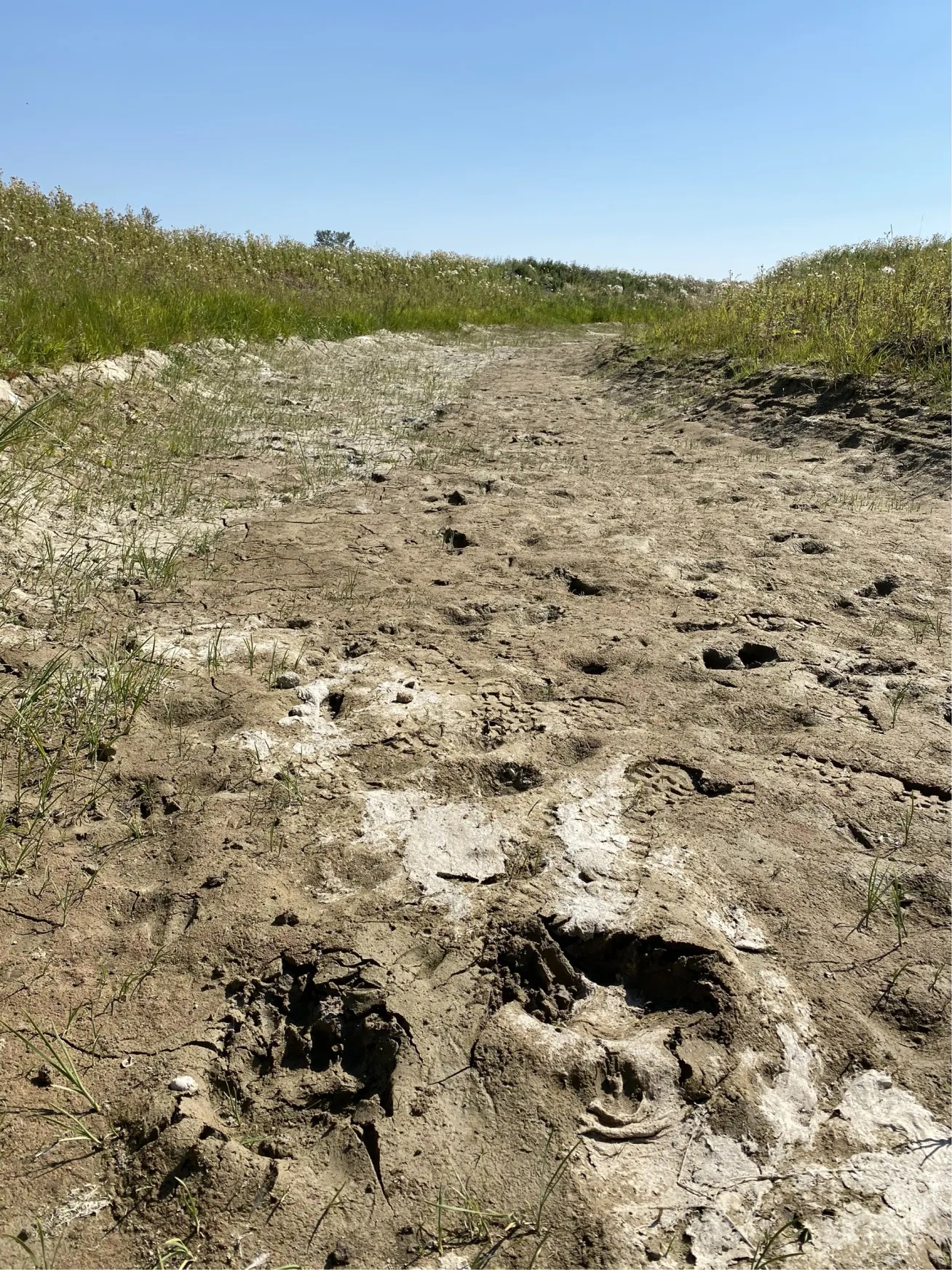
Bear Tracks: How to Read Black Bear and Grizzly Prints
3 min read
A bear track in soft mud is a small piece of anatomy left on the ground. It shows five toes, a broad pad and, sometimes, the marks of long claws. Learning to read those parts is the difference between guessing and knowing which bear passed by.
This guide covers what the published sources say about bear tracks: the shape of the foot, how front and rear prints differ, and the features that help separate a black bear from a brown or grizzly bear. It also covers what tracks cannot tell you, because no single mark settles the question.
What a bear foot leaves behind
The International Association for Bear Research and Management describes the American black bear as plantigrade, meaning flat-soled, with five toes and non-retractable claws. Plantigrade is the same way people walk, on the whole sole of the foot.
The US Forest Service notes that bear tracks have five toes, and claw marks are usually evident in the track. It adds that front tracks are shorter, while rear tracks are longer with a prominent heel similar to a human foot.
Front and rear print sizes
Alberta’s provincial guidance gives measurements for adults. In adult black bear tracks, the front print is 10 to 13 centimetres (4 to 5 inches) long and the back print is 15 to 23 centimetres (6 to 9 inches) long. For grizzlies, the same source gives a front print of 13 to 18 centimetres (5 to 7 inches) and a back print of 25 to 30 centimetres (10 to 12 inches) long.
Those ranges overlap at the edges. Alberta says plainly that a grizzly and a black bear of similar size will leave similar sized tracks. A big black bear can leave a print as large as a small grizzly. Size alone is a weak clue. The NPS says not to rely on colour and size alone.
Toe line and claw marks
The National Park Service teaches two track features. On a brown or grizzly bear, the toes are close together and form a fairly straight line. On a black bear, the toes are separated and fairly arced. Alberta says the same: clear black bear tracks show a curved line made by the front toes, while grizzly toes make a comparatively straight line.
The NPS also gives a line test. Draw a line under the big toe across the top of the pad. On a black bear track, that line runs through the top half of the little toe. On a grizzly or brown bear track, it runs through or below the bottom half of the little toe. It takes a clear, uncluttered print to use this, so treat it as a check and not as a rule.
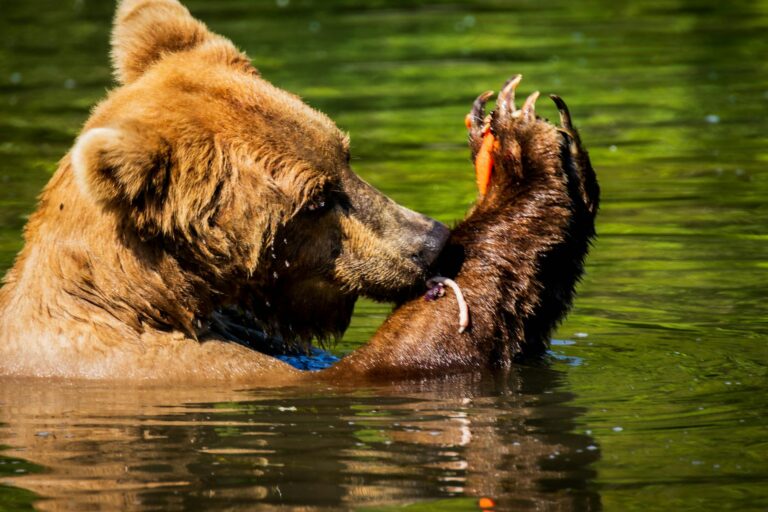
Claws are the other clue. Alberta says a black bear’s claws leave little or no imprint in front of the toes, while grizzly claw imprints are easier to see, usually 2 to 3 inches in front of the toes. The NPS puts grizzly and brown bear front claws at 2 to 4 inches long, depending on how much digging the individual does, and black bear front claws at under 2 inches. Our guide to bear claws covers why the species differ.
Why claw marks are not proof
The NPS warns that claw marks do not always show in black bear tracks, and the Forest Service says a combination of features works best. The NPS says claw marks are often visible in grizzly and brown bear tracks, so long claw marks point toward a grizzly or brown bear, but even then it advises using tracks and physical appearance together.
If you want the whole-animal version of this test, see seven ways to tell a black bear from a grizzly. It covers the shoulder hump, the face profile and the ears, which a track cannot show.
Reading tracks in practice
- Look at several prints in a line, not one. A single print can be smeared by slipping or a changing surface.
- Check toe arrangement first, then the claw distance, then size. Size is the weakest of the three.
- Note the ground. Snow, mud and fine sand hold detail. Gravel and dry grass hold almost none.
- Photograph a track with something for scale, such as a pen or a coin, held beside it.
- Treat any fresh track as a sign that a bear is nearby and follow normal bear-country precautions.
Tracks also tell you something simpler: a bear used this spot.
What is not known
The sources above give typical adult ranges and general rules, not guarantees. They do not set out how often these rules fail, or how juveniles of either species fit the ranges, so no reliable error rate can be quoted here. That is why the agencies tell you to combine clues.
Have you found bear tracks on a trail or a shoreline? Email us at hello@lovebears.org and tell us where and what you noticed.
Sources
- National Park Service: Bear Identification
- Government of Alberta: Know your bears
- US Forest Service, Custer Gallatin National Forest: Bear Identification
- International Association for Bear Research and Management: Ursus americanus
Photo: Jodi A. Hilty, Charles C. Chester, Pamela A. Wright and Kelly Zenkewich, CC BY 4.0, via commons.wikimedia.org.