How Scientists Study Bears: Hair Snares, Collars and DNA
4 min read
Bears are hard animals to count. They live alone, cover huge areas, hide in dense forest and spend winters in dens. Wildlife agencies still have to know how many there are and where they go, so biologists have built a toolkit that runs from barbed wire and scat to satellite collars. The National Park Service describes the range as tools that go from non-invasive, with no handling of the animal, to invasive, where a bear is captured and sedated.
Here is how each method works, what it can answer and where it falls short.
Scat analysis: what goes in must come out
The simplest method needs no contact at all. The Park Service puts it plainly: bear food habits are often studied by analyzing scat, as it is relatively easy to collect samples and does not require interacting with the bear. Scat shows which berries, insects, fish or fur a bear ate. It can also hold DNA. If you want to know what bears eat across the seasons, our guide to what bears eat draws on the same kind of evidence.
Hair snares and DNA
A hair snare is a low-tech tool with a high-tech result. Missouri biologists describe the setup: they stretch barbed wire around three or more trees and add scent lure to entice bears to approach. The wire is set so a bear has to crawl under or over it, and strands of hair catch as it passes.
The hair goes to a lab. Each sample carries DNA, and each bear has its own. Counting the distinct genetic profiles shows how many individual bears visited. No bear is trapped or handled, which matters because capture is stressful for the animal.
Missouri used this approach on a returning population. The Missouri Department of Conservation reports that the estimated bear population has grown from about 300 to nearly 1,000 since 2011. In 2022 and 2023 the agency ran a larger hair-snare study across most of the lower half of the state and collected about 1,000 hair samples. The October 2024 article said DNA results were expected in 2025.
Bear rubs and mark-recapture
Bears rub against trees, and they leave hair behind. Researchers can sample those rubs the same way. A 2012 study in PLoS One compared hair traps and rub surveys in Banff National Park, Alberta. Hair traps had high detection rates for female grizzlies and for black bears of both sexes, but extremely low rates for male grizzlies. Rubs did the reverse: high detection for grizzlies of both sexes, low for black bears.
The lesson is that no single method sees every bear. Using two together gives a more complete count. The same study produced the first precise abundance estimates for the Bow Valley: 73.5 grizzlies in 2006 and 50.4 in 2008, with 62.6 black bears in 2006 and 81.8 in 2008. Those are single-valley figures from those years, not a park-wide or current count.
The statistics behind this are called mark-recapture. In the traditional version, bears are physically captured, marked with a tag and released, then seen again later. DNA does the marking instead: the genetic profile is the tag, and the hair snare is the recapture.
Camera traps
Motion-sensor cameras catch what people rarely see. The Park Service notes that bears alter their behavior in the presence of people, so remote cameras offer an opportunity to capture behaviors that humans rarely observe. One camera in Glacier National Park was set up near a tree that bears use for rubbing. Cameras can also stand in for the recapture step: biologists use them to see how often tagged bears appear.
Aerial surveys
Where bears live in open country, such as tundra or alpine slopes, researchers can count from the air. A pilot flies a straight line for a set distance while an observer counts the bears in sight on either side. Because the distance flown and the viewing width are known, the count can be scaled up to an estimate for the whole area. The Park Service describes it as a method for open areas that are hard to reach.
Collars and telemetry
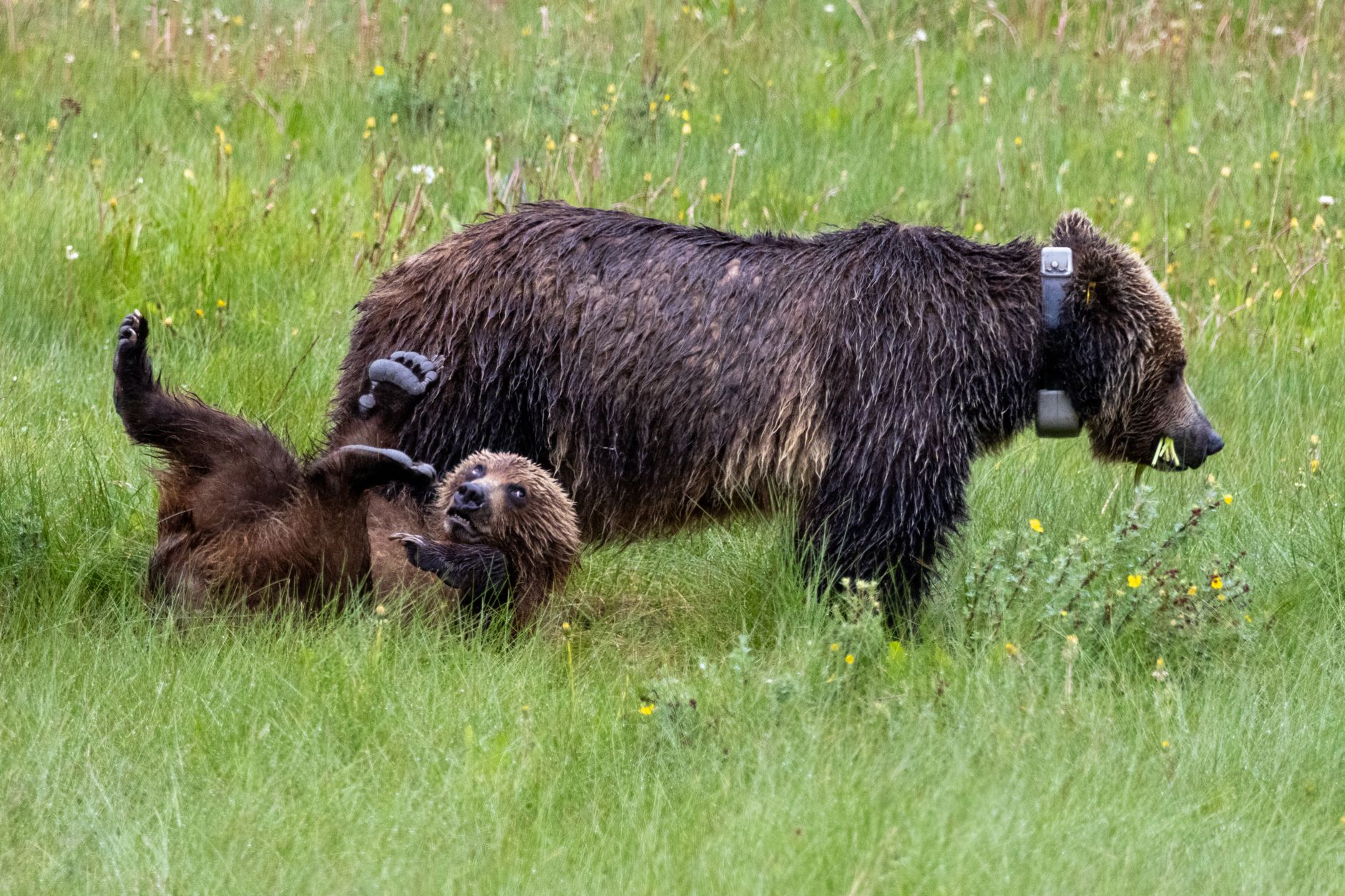
A collar tells researchers where one bear goes, day after day. With radio telemetry, researchers must be relatively close to an animal to detect its signal, whether on foot, from a truck or from an aircraft. The same page credits Frank and John Craighead with the first radio collars used on grizzlies in Yellowstone in the 1960s.
GPS and satellite collars changed that. Satellite telemetry has been used since the 1980s to track animals over longer distances without the researcher needing to be near the animal, and it has changed how scientists study species with large home ranges, such as polar bears that spend much of their time in places people cannot reach.
For winter behavior, see our post on how and why bears hibernate.
Collar data and DNA work well together. Missouri’s biologists distributed their hair snares based on radio collar data and bear sightings, then combined the population estimate with survival and recruitment figures from GPS-collared bears to follow change over time.
Reading the diet from tissue
When a bear is sedated for a collar, researchers often take a hair or skin sample. The chemical content of this tissue can be analyzed to determine the balance of plant and animal material in a bear’s diet. The same analysis works on old bones, teeth and hair kept in collections. A study of samples from 1915 to 2007 in Yosemite showed that human foods in bear diets rose with park visitation until the 1990s, when strict food-storage rules arrived, and that today’s Yosemite bears eat a diet once again similar to bears of the early 1900s. For the behavior side of that story, see how Yosemite bears are getting smarter.
What the methods cannot tell us
Every method has gaps, and good studies say so. Hair snares caught male grizzlies at very low rates in Banff. Aerial counts need open ground. Collars follow only the animals that were caught, so researchers have to ask whether those bears represent the rest. Pharmaceutical research has also produced safer and lower amounts of anesthesia drugs, according to the Park Service.
Population estimates also come with ranges, not single true numbers. When you see a figure for a bear population, check the year, the method and the area it covers.
Sources
- National Park Service: Evolving Research Technologies (Bears)
- Missouri Department of Conservation: Nature Lab, Black Bear Population Study (October 2024)
- Sawaya et al., PLoS One 2012: Estimating Grizzly and Black Bear Population Abundance and Trend in Banff National Park Using Noninvasive Genetic Sampling
Have you seen a collared bear, a hair snare or a trail camera photo of a bear? Tell us what you know in the comments.