Bear 909: Beadnose’s Daughter and Three Generations at Brooks Falls
Last updated: October 14, 2026
4 min read
Bear 909 is not the biggest bear at Brooks Falls and she has never won Fat Bear Week. She is interesting for a different reason: she is a second-generation Brooks River bear with a documented family line running in both directions, and following her is the closest thing the cams offer to watching a dynasty.
For the wider Fat Bear Week bracket and the bears worth knowing, our Fat Bear Week pillar is the place to start. For the species biology behind the cast, see our brown bear profile.
Who Bear 909 is
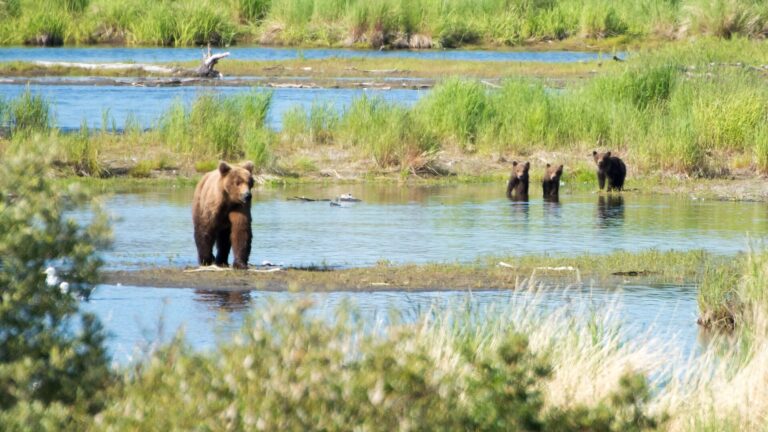
Bear 909 is an adult female brown bear born in 2016 at Brooks River in Katmai National Park. Her mother was Bear 409 Beadnose, the sow who won Fat Bear Week in 2015 and again in 2018, and 909 learned to fish at the falls alongside her. Her sister, Bear 910, is on the river too.
She is described by explore.org as medium-brown, with blond ears and a prominent shoulder hump. If you are trying to pick her out on the cam, the ears are the giveaway.
Her cubs
909 has raised cubs of her own at Brooks, and one of them has won the Fat Bear Junior bracket twice, the separate contest for cubs and yearlings that runs just before the main event.
- Bear 609, her daughter, also known as 909 Jr, won Fat Bear Junior twice: as a yearling in 2022 and again in 2024. 609 stayed on with her aunt 910 and 910’s cub through the summer of 2024, an unusually long apprenticeship, and only began living independently after 910 separated from her own litter in spring 2025.
Not every year goes well. 909 lost a cub from her first litter, and the three spring cubs she emerged with in May 2025 had all disappeared by June. Nobody knows why. The cams show the good years and the bad ones with the same indifference, which is part of what makes them worth watching.
How she fishes
Losing her 2025 cubs changed her behaviour quickly. Freed from watching over dependent cubs, 909 adapted to solitary life and fished more boldly, including in the plunge pool directly below the falls, which is contested water. She went into the autumn well fed. In 2026 she had two spring cubs and lost both: one disappeared early in the summer, and on 28 July Bear 806, another mother, killed the second.
That is the arithmetic behind Fat Bear Week in a single bear. A sow nursing cubs pours calories into milk. A sow without cubs puts them on herself.
Fat Bear Week record
909 has never won the adult bracket. In 2025 she won her first-round match, then lost to Bear 128 Grazer, the eventual semi-finalist. In 2026 she beat Bear 428 Studious in the first round, 155,899 votes to 51,493, then lost to her sister 910 in the quarter-finals, 26,766 to 104,545.
What a subadult looks like
Several of 909’s offspring have passed through the stage the cam community finds hardest to follow and most rewarding to watch: the subadult years, after separation from the mother but before full adult size or any settled rank. At Katmai that roughly spans ages three to six or seven, though the boundaries are fuzzy.
Subadults fish where they can. The lip of the falls belongs to the dominant boars and the riffle is contested by experienced sows, so young bears work the slower pools, scavenge dropped fish, fish well downstream, and try the high-value spots at dawn or dusk when the lip clears. They are also the bears most likely to be displaced: the clip that always circulates is the small bear who has finally landed a sockeye, only for a passing adult to walk off with it.
On the cams you can pick them out by a few signals:
- Smaller bodies and longer legs relative to body length than the adults around them.
- Coats that often look patchier or paler.
- A tentative fishing style, with a lot of looking around between attempts.
- A position on the edge of the action rather than at the lip.
For broader tips on photographing the cast at Brooks Falls, our bear photography guide covers gear and behaviour reading.
Conservation context
Subadult survival is one of the metrics that matters most to a bear population’s long-term health. A river that reliably produces identifiable young bears, three generations deep in Beadnose’s case, is a river with enough food, enough habitat and enough protected space. The Bristol Bay sockeye run and the protections of Katmai National Park are the structural reasons. For the wider story of how the eight bear species are doing, see our bear conservation pillar.
FAQ
Who is Bear 909?
Has Bear 909 won Fat Bear Week?
What happened to 909's 2025 cubs?
What is a subadult bear?
How do you tell a subadult from an adult on the cams?
For more bears in this cast, read our profiles of Bear 480 Otis, Bear 747, Bear 128 Grazer, and Bear 32 Chunk. To understand the bracket itself, head to our Fat Bear Week pillar.
Updated 28 September 2026: corrected the Fat Bear Junior record of her daughter 609 and her Fat Bear Week results, and added her 2026 season.