

Are Pizzly Bears on the Rise?
Last updated: November 5, 2026
3 min read
When a grizzly bear and a polar bear mate, they produce offspring known as a pizzly bear, also called a grolar bear or polizzly. The short answer to whether pizzlies are on the rise is a cautious “possibly.” A warming Arctic is pushing grizzlies north and polar bears ashore, which puts the two species in the same place at the same time more often, but confirmed wild hybrids are still extremely rare. Here is what is actually known, separated from the headlines.
The First Confirmed Pizzly: Banks Island, 2006
The first wild pizzly bear was confirmed in April 2006. Jim Martell, a hunter from Idaho, shot the animal near Sachs Harbour on Banks Island in Canada’s Northwest Territories while on a guided polar bear hunt with local guide Roger Kuptana. Martell believed he had taken an ordinary polar bear. Officials grew curious because, while the bear had the thick creamy white fur of a polar bear, it also showed clear grizzly traits: long claws, a pronounced shoulder hump, a dished face, and brown patches around the eyes, nose, back, and feet.
A DNA test carried out by Wildlife Genetics International in British Columbia settled it. The bear was a true hybrid, with a polar bear mother and a grizzly bear father. That single animal put the pizzly into the global spotlight and gave the media a string of portmanteau names. There is still no scientific consensus on which term to use.
Why Two Species Can Even Interbreed
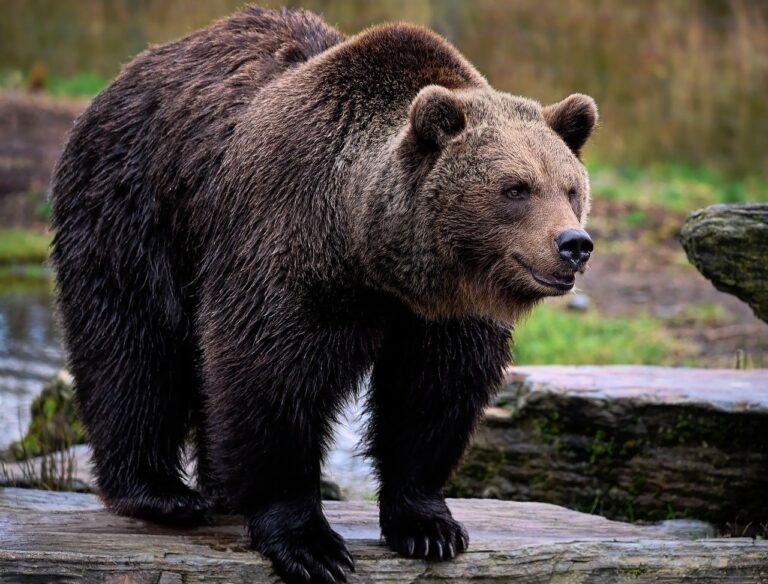
The brown bear (which includes the grizzly) and the polar bear split from a common ancestor relatively recently in evolutionary terms, with most estimates placing the divergence somewhere in the range of several hundred thousand to around half a million years ago. That is recent enough that the two species never became genetically incompatible. Their chromosomes still match closely enough to produce fertile offspring, which is unusual and is the key reason pizzly bears exist at all.
Genetic studies, including whole-genome studies, have shown something more interesting still: gene flow between the two species has been bidirectional. Brown bears and polar bears have inherited genes from one another over time. In other words, polar bears are not only gene givers in this relationship, they are also gene recipients. Interbreeding is not a brand new phenomenon caused only by modern climate change; it has happened on and off through the long shared history of the two species.
What a Pizzly Bear Looks Like
Pizzly bears tend to blend the features of both parents in ways that can be predicted:
- Coat: usually off white or creamy, often with brown or buff patches, intermediate between polar white and grizzly brown.
- Build: a visible shoulder hump inherited from the grizzly, which polar bears lack.
- Claws: longer and more curved than a polar bear’s, suited to digging like a grizzly.
- Head: a face shape partway between the long, streamlined polar bear skull and the broader, dished grizzly skull.
- Feet: partially furred soles, a polar bear adaptation, sometimes with the longer grizzly claws.
Are Pizzlies Really Increasing?
This is where the hype outruns the evidence. As the Arctic warms, grizzly bears are expanding their range northward and polar bears are spending more time on land, so the overlap zone is growing. But confirmed wild pizzlies remain very few in number. Notably, several of the hybrids documented in the western Canadian Arctic were traced back to a single female polar bear, meaning the gene pool of known wild pizzlies is tiny. Conservation researchers, including work highlighted by Polar Bears International, describe hybridization between the two species as extremely rare rather than common.
The Future of Polar Bears
It is tempting to imagine pizzlies as a built in rescue plan, a hybrid that could survive on both land and ice and carry polar bear genes forward. The reality is less comforting. Pizzly bears do not breed often or in large numbers, and they are still being born into a habitat that is disappearing. If polar bears lose their sea ice within a few human generations, there is simply not enough time for a slow, rare hybrid to establish itself as a new stable species.
The honest takeaway is that pizzly bears are a fascinating signal of a changing Arctic, not a solution to it. They show two species being pushed together by a warming world, but the better outcome by far is protecting the sea ice that the polar bear genuinely depends on. To understand what is at stake, read our full polar bear species profile.
This article is part of our guide to the eight bear species, which links every species profile and viewing guide on the site.
Updated 28 September 2026: corrected which genetic studies showed two-way gene flow.




Were the hybrids from that single female fertile themselves? If pizzlies can breed back with grizzlies, that seems like a bigger story than the first one shot in 2006.