

Albania’s Last Restaurant Bear is Free
Last updated: November 5, 2026
3 min read
Mark was Albania’s last restaurant bear, and in December 2022 he finally walked out of his cage. For more than twenty years he had lived in a small concrete pen outside a restaurant near Tirana, kept as a roadside attraction to pull in customers, eating scraps handed over by passers-by. On 7 December 2022 the animal welfare organisation Four Paws took him out, and two days later he arrived at BEAR SANCTUARY Arbesbach in Austria.
The journey took about 44 hours. With his rescue, the era of the restaurant bear in Albania came to an end.
What a restaurant bear actually is
The phrase sounds almost quaint. It was not. Restaurant bears were wild brown bears, usually taken as cubs, then kept in small cages outside cafes, restaurants and petrol stations as a living advertisement. A bear draws a crowd, and a crowd spends money. The animal got nothing out of the arrangement.
Mark’s cage was a cramped concrete cell. Years of an unsuitable diet of scraps and sweets left him overweight with broken and decaying teeth. Like many long-term captive bears he had developed stereotypic behaviour, pacing the same short line over and over, which is a recognised marker of severe stress in a barren enclosure. A bear in a proper habitat forages, digs, climbs and covers ground. Mark could do almost none of it.
The campaign that emptied the cages
Mark was the final bear in a long effort. Through its Saddest Bears campaign, Four Paws spent years locating captive bears across Albania, negotiating their release, and finding sanctuary places for them. Some went into Four Paws’ own sanctuaries and others to partner facilities elsewhere in Europe. Mark’s release closed the list.
Four Paws has been consistent that rescue on its own is not the goal. Emptying the cages one bear at a time only works if the law and its enforcement change behind you, otherwise the next cub ends up in the next cage. The organisation has kept pressing Albania on legislation and on support for proper sanctuary provision rather than private captivity.
A wider problem across southeast Europe
Albania is not unique. Caged bears outside restaurants, hotels and roadside stops have been a recurring problem across southeast Europe, which is why Four Paws built a regional campaign around them. The animals are European brown bears, the same species still living wild in the Balkan mountains, so every caged bear is one pulled out of a living population. Ending the practice country by country is slow: tracing every animal, negotiating with owners, arranging cross-border transport, and finding a sanctuary place for a bear that may live another decade. Reaching the last bear in Albania took years.
Mark’s new home in Austria
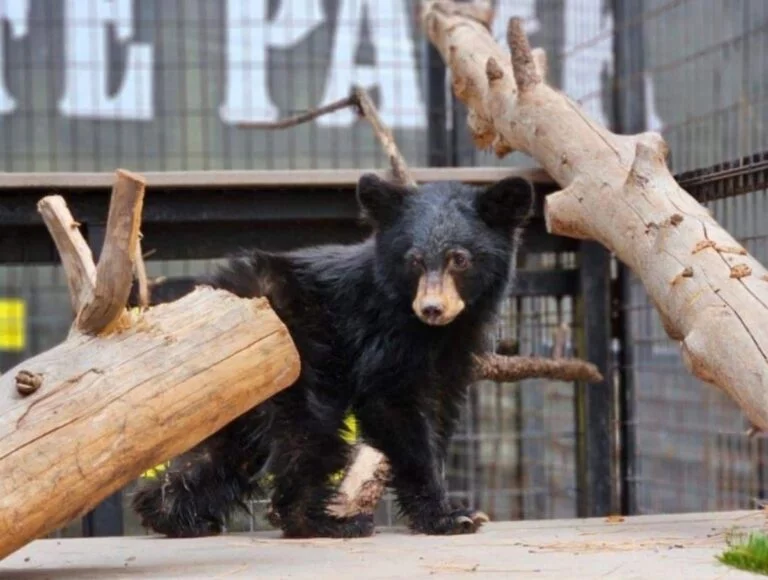
BEAR SANCTUARY Arbesbach, in Lower Austria, has given rescued bears a permanent near-natural home since 1998. It offers space to bathe, dig, climb, roam and retreat into caves to hide and hibernate. Mark joined a small group of resident bears in a habitat of woodland and meadow.
For a bear who had spent his whole adult life on concrete, even the ground was unfamiliar, and keepers expected he would need time before he was ready to walk on grass and soil. His new life came with a species-appropriate diet and a team managing the health problems the cage had left him with, from his weight to his teeth.
Update: Mark died in September 2025
Mark lived just under three years at the sanctuary. He died in September 2025, of health complications rooted in his decades in the cage. It is a blunt reminder of what twenty years on concrete does to an animal: sanctuary care can give a bear a real life back, but it cannot undo the damage. Three years of grass, water and space is not nothing, and it is also not much set against what was taken.
Why sanctuaries, not the wild
It is a fair question why a rescued bear cannot simply be released back into the forest. After two decades in a cage, a bear like Mark had never learned to find natural food, build a den or avoid danger. Release would have been a death sentence. A good sanctuary is a compromise: not true freedom, but a dignified, near-wild life with veterinary care for an animal that can never go home. To learn how brown bears live when they are wild and free, see our brown bear species profile.
Mark’s story is both a victory and a warning. Albania’s cages are empty. The conditions that filled them in the first place are the part that still needs fixing.
Bring bears home
Love what you read? Browse the We Love Bears store for gear and gifts inspired by these incredible animals:
- Shop bear plush toys
- Shop bear books
- Shop bear mugs
Every purchase supports more bear content on this site.
This article is part of our bear conservation guide, which links all our conservation, rescue and wildlife crime reporting.
Updated 28 September 2026: corrected the transport details and removed an unsourced weight.


I remember caged bears outside roadside cafes on family drives through the Balkans as a kid. Nobody around us thought twice about it. Hard to believe the last one in Albania only left recently.