
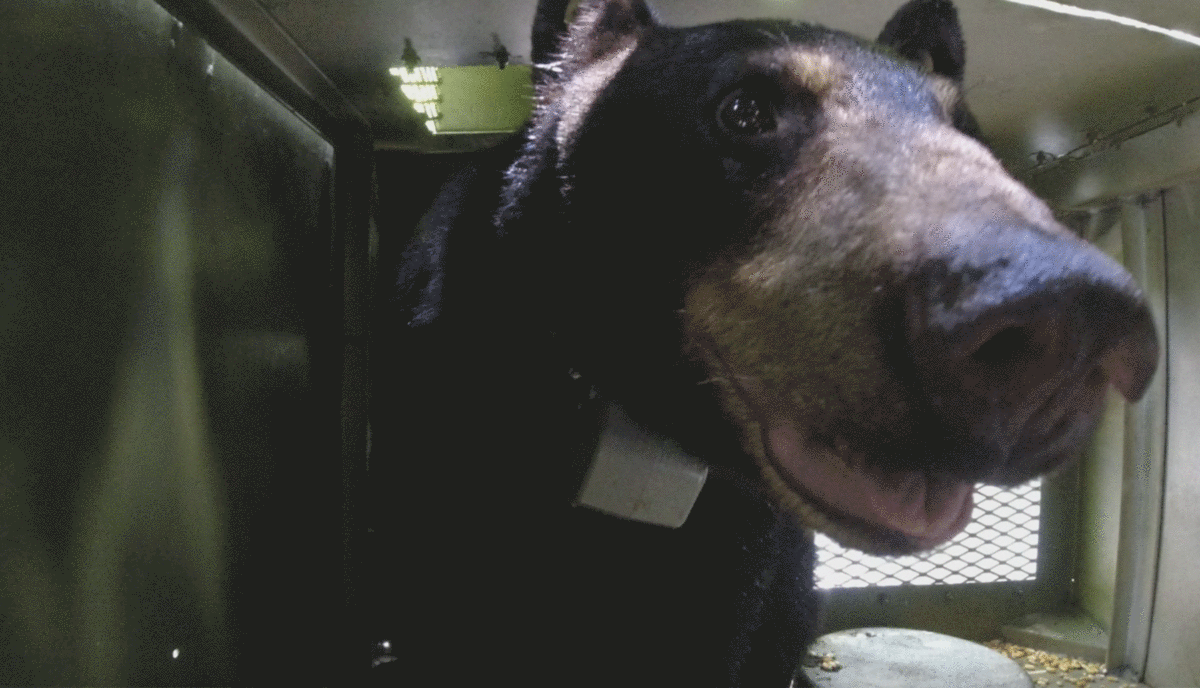
Bear 609 Traveled 1,000 Miles Back Home
Last updated: November 5, 2026
2 min read
A black bear known as 609 was moved out of Great Smoky Mountains National Park and then walked roughly 1,000 miles through four states. She is the longest-travelling relocated bear the park has ever tracked, and her route says more about why relocation rarely works than any policy document could.
Why she was moved
609 was food-conditioned. She was pulling food out of fire rings and challenging visitors for their backpacks. Bill Stiver, a wildlife biologist with the park, said staff first tried releasing her back where she was caught, which is often enough to put the fear of people back into a bear. She returned the following year and carried on.
So the Park Service fitted her with a GPS collar and released her in the Cherokee National Forest, about 45 to 50 miles from where she was trapped.
The route
She started moving south almost immediately, crossed Georgia and South Carolina, looped around Asheville in North Carolina, turned north and came back into the national park. She ended up within five or six miles of where she had been caught. Stiver put that first circuit at 300 to 400 miles.
Then she did it again, bigger. A second loop of roughly 450 to 500 miles took her back through Georgia, South Carolina, North Carolina and Tennessee. She was spotted at a shopping mall in Alpharetta, Georgia, where a car hit her. She kept going, across interstates and through built-up areas. “She just kind of never stopped moving,” Stiver said.
By the end of 2022 she had denned back in the Cherokee National Forest in Tennessee, about 20 miles from where she was let go, and her collar was swapped while she slept. Before her, the longest tracked journey by a relocated Smokies bear was about 215 miles, in 2020.
What the tracking study found
609 is one animal in a three-year study following what actually happens to bears after the park moves them. The headline finding is bleak: Stiver has said around two-thirds of relocated bears are dead within four to five months. Moved bears cross roads they do not know and wander into hunting country.
That makes 609 unusual as much for surviving as for the distance. Relocation looks like the humane option, and for a food-conditioned bear it often is not much of one.
How a bear navigates that far
Honestly, nobody is certain. Black bears have a well-documented homing ability, and the usual explanations combine a very good nose, a strong memory for terrain, and possibly some sensitivity to the Earth’s magnetic field. Why 609 kept going instead of settling once she got back is still open. A female black bear in decent habitat normally lives inside a home range of a few dozen square miles, which makes the scale of this harder to explain, not easier.
The fix starts with people
609 was taught to raid campsites. Every open cooler and unattended pack was a lesson, and it is a lesson that is close to impossible to undo. Stiver points people at BearWise.org for what to do and what not to do in bear country.
Great Smoky Mountains is the most visited national park in the United States and holds an estimated 1,900 black bears, about two per square mile. That density is why the two species meet so often there, and why food storage is not a formality.
For more on the species, read our American black bear profile.
This article is part of our bear conservation guide, which links all our conservation, rescue and wildlife crime reporting.


two thirds dead within four or five months is grim. makes relocation sound like moving the problem somewhere we can’t see it. but what else is a park supposed to do with a bear like her?