
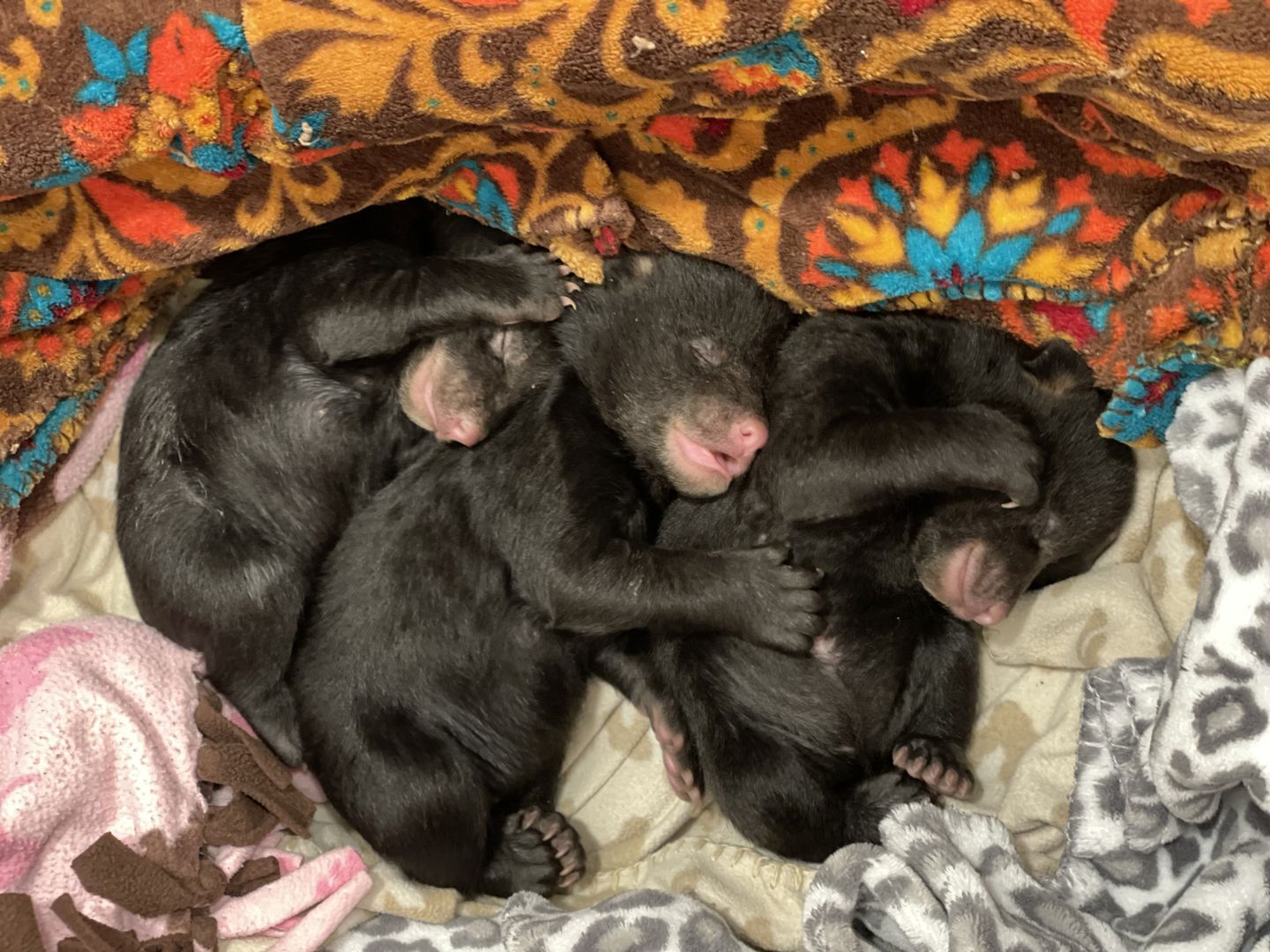
Three Black Bear Cubs Rescued in New Hampshire
Last updated: November 5, 2026
3 min read
Three newborn black bear cubs were rescued in Peterborough, New Hampshire in February 2022 after a work crew accidentally destroyed their den. Within days they were warm, fed and safe at a rehabilitation centre.
The property owner had contractors in to clear brush and cut down trees. Nobody knew a sow and her three cubs were sheltering next to the property until the den was already gone. The mother ran into the woods and left the cubs behind.
In most cases a sow comes back for her young once people leave, and New Hampshire Fish and Game will usually wait and watch rather than intervene. This time the judgement went the other way. Machinery and crew were still on site, the den was metres from an occupied house, and the cubs were far too small to last a February night in New England on their own.
Why the cubs could not wait for their mother
American black bears give birth in January or early February, while the sow is still denned. Cubs are born blind, almost hairless, and weigh a few hundred grams. They cannot regulate their own temperature and depend completely on the mother’s body heat and milk for the first months. A litter exposed in early February has no margin at all, which is why the call to take them was urgent rather than optional.
The timing points at a wider seasonal problem. Late-winter land work, from logging to lot clearing, keeps colliding with denning season, because black bears often den in brush piles, hollow logs, root masses and dense thickets rather than caves. What looks like an untidy corner of a property to a contractor can be an active nursery.
Where the cubs went next
A Fish and Game conservation officer and a department biologist made the decision to take the litter, and the cubs were driven to the Kilham Bear Center in Lyme, New Hampshire, the state’s black bear rehabilitation facility.
There were two females and one male. They were named Willa, Billie and Fitz. The male got his name because the first reports had the den in Fitzwilliam rather than Peterborough, and the name stuck once the mistake was corrected. The two females weighed a little over three pounds each. Fitz was just over two pounds, most likely the runt. Staff confirmed all three were eating and settling within their first few days.
What the Kilham Bear Center does
The centre, founded by black bear researcher Ben Kilham, takes in orphaned, injured and abandoned cubs and works in partnership with New Hampshire Fish and Game. It has raised and released hundreds of bears.
The whole process is built to minimise bonding with people:
- Very young cubs start indoors where they can be bottle fed and kept warm.
- As they grow they move out into large forested enclosures.
- In the wooded pens they teach themselves to climb and forage, finding natural food by smell.
- Cubs taken in during one spring are typically released by Fish and Game the following spring, once they can fend for themselves.
So a litter rescued in February is not freed within weeks. Willa, Billie and Fitz would have spent more than a year at the centre, learning what their mother would normally have taught them, before going back out as yearlings.
Check your land before you clear it
If you are planning outdoor work in bear country between November and April, survey the ground first. A wildlife biologist or game warden can check a property for active dens, and Fish and Game can advise on timing the work to miss denning season.
A disturbed den does not always end this well. These three were found quickly, the weather held, and a specialist facility had room. The better outcome was the one where nobody had to intervene at all. For more on living alongside bears, see our bear safety guide.
This article is part of our bear conservation guide, which links all our conservation, rescue and wildlife crime reporting.



We had brush cleared at the back of our lot two winters ago and nobody checked for anything. Reading this, I wonder what we could have missed. Who do you call to have a property checked for dens?
Your state wildlife agency is the first call. They will either send someone or tell you what to look for: brush piles, hollow logs and root masses. I would book the work for before late autumn, when bears start settling in.